Part II
Kongo at the Carroll House (1986-1990)
Between 1986 and 1990, archaeologists excavating the Annapolis Carroll House uncovered physical evidence of enslaved African religious practice—crystals, shells, and ritual objects—hidden beneath the foundations of one of the most powerful slaveholding families in colonial America. The Archaeology Department at the University of Maryland, College Park, and the Historic Annapolis Foundation conducted a research project that included excavating the garden surrounding the Charles Carroll House in Annapolis.

The Carroll House in Annapolis on Spa Creek, formerly Carroll Creek, walking distance to the state capital and Naval Academy.
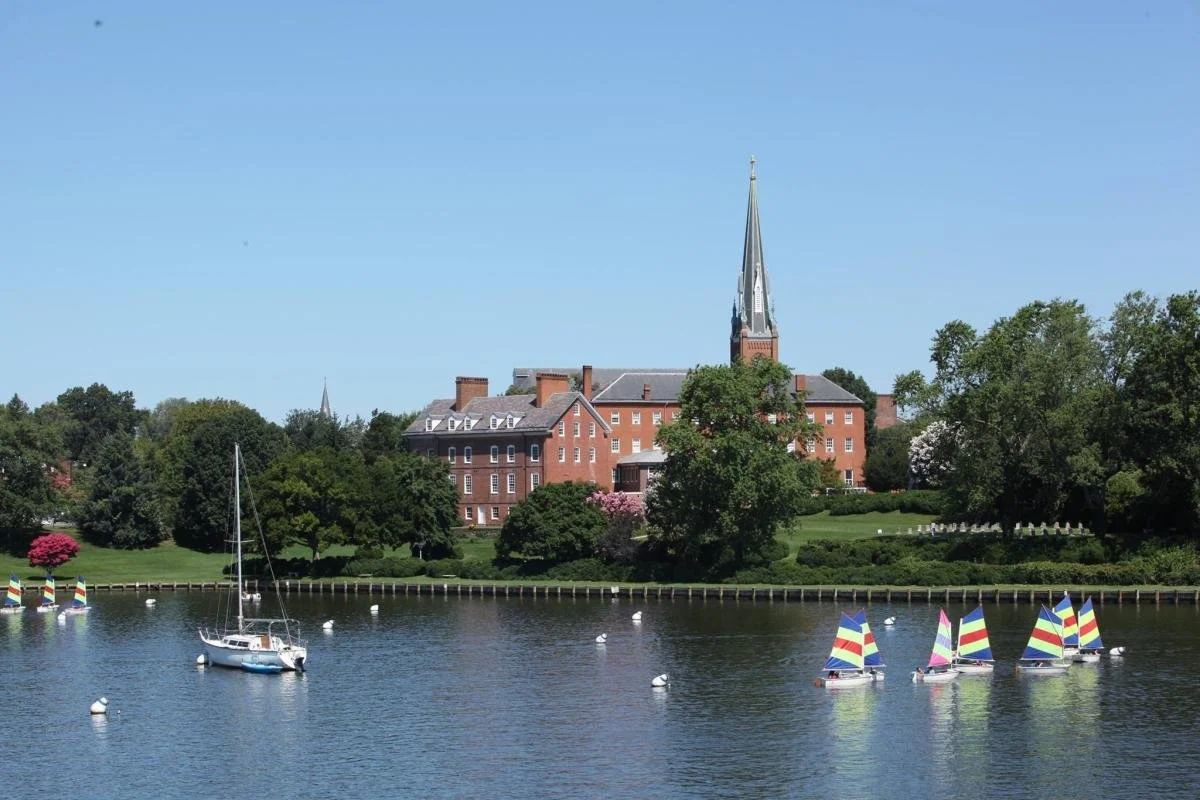
View from Spa Creek
The Annapolis Carroll house is central to so much of this research. “The 18th-century landscape and its relationship to the house, and evidence of the 18th century frame house which had been attached to the extant brick house, were discovered during these excavations (Kryder-Reid 1991; Kryder-Reid, Leone, Einstein and Shackel 1989; Leone and Shackel 1990).
Charles Carroll the Settler, the first of five generations of men with the same name to inhabit Maryland, purchased the House after he had already inherited many slaves, and it is where he died mysteriously on its back steps, just as his slave empire was beginning to take off. “In 1991, the Project was retained by the Charles Carroll House of Annapolis, Inc., a restoration organization, to excavate the ground floor of the brick mansion prior to interior restorations of the structure.” Evidence of enslaved religious practice was found in the basement of the Annapolis house. This subterranean space, from which the enslaved people served their masters food through a hole in the floor, had since been ungrounded by the Redemptorists monks, who also added windows, likely in the mid-19th century when the house was bequeathed to them by the Carroll descendants. The basement, even with the new windows and airflow, still smells like human captivity and was most likely much worse prior to Redemptorist excavation.
During the 1980s excavations, almost 150 years after the original basement excavation, several quartz crystals and associated artifacts were recovered on the ground floor of the Charles Carroll House. The scholars involved (Dr. Frederick Lamp, Baltimore Museum of Art; Dr. Peter Mark, Wesleyan University; Dr. Robert Farris Thompson, Yale University, 1992), agreed that crystals "to have been used by slaves and to be related to African divination and conjuring practices.” Though the article, authored by Dr. Lynn Jones, cites Dr. Lamp, Dr. Mark, and Dr. Thompson, it mostly relies on Dr. Wyatt McGaffey and his findings in Art and Healing of the Bakongo. For McGaffey, “[a]ll of these items from the caches at the Carroll House are similar to the items included in the minkisi described by Bakongo healers..”
In Art and Healing of the Bakongo, Wyatt MacGaffey has translated KiKongo texts describing and explaining the uses of minkisi (plural for nkisi). A nkisi, plural minkisi, in west-central African lore, is any object or material substance invested with sacred energy and made available for spiritual protection. MacGaffey relies on 19th century Swedish monk Karl Layman's interpretation of 45 minkisi, from Catholic-practicing Kongolese with first-hand knowledge of Western African religious practice. In the early part of the 20th century, several African healers or diviners gave their minkisi to the Swedish missionary, Karl Laman, who collected these objects and recorded much information about them as the healers explained in their own languages how these minkisi were made and used. 68 Kongolese authors contributed to Dr. Laman’s, 20 who contributed significantly, MacGaffey includes 10: Babutidi Timotio, Demvo Thomas, Kavuna Simon, A.M. Latungu, Letete Esaya, Lwamba Joseph, Makundu Tito, Matunta and Nsemi Isaki. MacGaffey relies on the Swedish Laman’s work and the spiritual understandings of his Kongolese interpreters. The words are an anglicization of African words with a definition of what each word means. The minkisi are separated into four categories by MacGaffey: divination, healing, wealth, and warfare. But in both cases, the authors acknowledge there is no English translation for nkisi.
The large cache of objects found at the Carroll House included crystals, a clear bead, a smooth black stone, and a bowl with a design resembling a Bakongo cosmogram. According to MacGaffey, the bowl may have been used as a container for the crystals and other objects. Another group of artifacts from the Carroll House included crystals, an ivory ring, and a bubble shell. The scholars involved and MacGaffey all agree that the Carroll House artifacts tie closely to Bakongo minkisi. Though these articles use the artifacts to demonstrate how African traditions maintained some continuity throughout the Atlantic slave trade, the authors fail to explain why these findings are so significant. The articles make many generalizations about bakongo cosmograms, the meaning of (m)nkisi, and Kongo healing practices, with the assumptions that African theology and Catholicism first collided in America, which could not be further from the truth. The enslaved had not only already been exposed to Catholicism, but over hundreds of years had consumed it, changed it, and made it their own. They came to America with an evolved version of Catholicism that, in many ways, they intentionally subverted in favor of their African traditions.
Historically speaking, Alfonso I's critiques of Roman Catholicism were no less profound than Henry VIII's critiques.
Almost any item, natural or manufactured, could be transformed into an nkisi through the appropriate human activity or ritual. Thus carved objects, human figures, pots, burial mounds, churches, and even human bodies could become minkisi under the appropriate circumstances the grave and the body buried in it were considered to be a special type of nkisi. -54
It was 1509, the year Henry VIII became King of England and three hundred years before the enslaved at Annapolis were assembling and engaging with their caches, when Kongo King Alfonso I conquered his “pagan” brother, Mpanzu a Nzinga, and declared Kongo a Catholic nation.
Alfonso enjoyed the longest and one of the most important reigns in Kongo history (1506-43). “By the end of his reign in 1543, Alfonso had effectively instituted Christianity as part of the body politic in the country, supported by the newly strengthened Christian Church. His efforts to educate Kongo’s young; his tireless attempts to suppress other ritual practices; and his undying faith in Catholicism, combined to establish Christianity in Kongo from the 16th century onward.” Kongo is the nation in which Kikongo was spoken and bikongo rituals were undertaken.
If Kongo is the African nation from which the caches are said to originate, the people who created these caches had very likely not only already been exposed to Catholicism but had already made Catholicism their own.
Despite the two hundred turbulent years between the Alfonso I victory and the beginning of the 18th century, Kongo Catholicism, an independent branch of the Church in its own right, though not recognized as such by the Roman Church, was redeemed and reinvigorated when a divinely inspired kikongo woman was possessed by the spirit of St. Anthony of Padua.
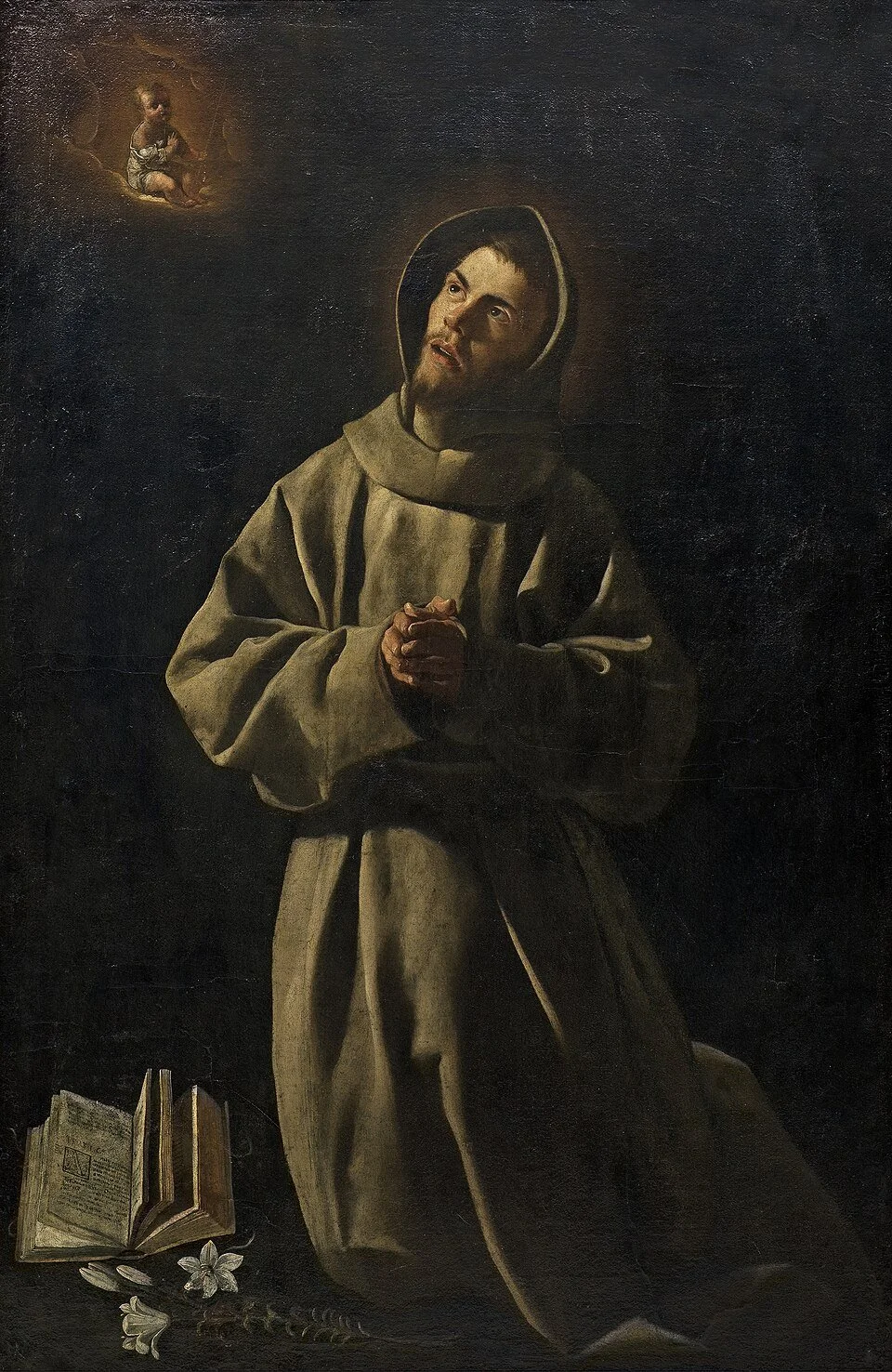
“St Antonio de Padua” Francisco de Zurbarán, 1650
St. Anthony, renowned worldwide for his mission to the poor, was especially relevant to the Kongo people, who once oversaw a wealthy global power, and inherited corruption and division in its place. But the possession also mattered to the less-Catholic rural African Kongo people, who saw Dona Beatriz Kimpa Vita as a manifestation of their own ritual practices around the mkisi and ancestors. Vita, as Dona Beatriz Kimpa Vita is also known, was killed by the Portuguese, but like the central deity of Christianity, her death only strengthened her followers' resolve. The scholars relied upon for the article “Crystals and Conjuring at the Charles Carroll House, Annapolis, Maryland” seem to be making the same mistakes and generalizations that the Portuguese made more than 500 years ago, diminishing and underestimating the complexity of spiritual life that the enslaved African people arrived at the Chesapeake and Low Country with. In his book Rituals of Resistance, Prof. Jason Young talks about the process by which the Portuguese and Capuchin monks converted Kikongo people in the 15th century. But today, similarly, there is much written about the presence of bakongo and kikongo cosmologies and religious practices without a proper accounting of Kongo religious history. Even these scholars who attempt to show continuity between African-American religious practice and Africa, fall short of telling the full story.
Though the article gives the perception that it is countering this pervasive belief, it is doing the opposite. The reader is expected to stop their inquiry at the "bakongo" cosmogram or "nkisi" object used for conjuring. The implication is that African religious practice before its interaction with white North American Christianity was alien to Abrahamic religion (Islam, Judaism, and Christianity) and that these Kongo cosmograms, caches, and nkisi are primitive African practices long since abandoned by black people. Again, this is a distortion of the truth. The reality is that the enslaved people in North America were a rich diaspora of West and Central African countries, that included people who had been exposed to Islam in the eighth century and Christianity in the 15th century, on the African continent where the stories of the Bible actually took place.
In the United States, the biblical story of Moses was especially available and relevant for the enslaved reinterpretation. Mansa Musa’s people had been brought to Maryland and Virginia. And for the men named, and women nicknamed, Moses, a special responsibility was given to liberate their people. Not only did the name Moses come with special responsibilities, but it was also used as code. Just saying the name was a spiritual practice, a liberatory spell meant to conjure freedom.
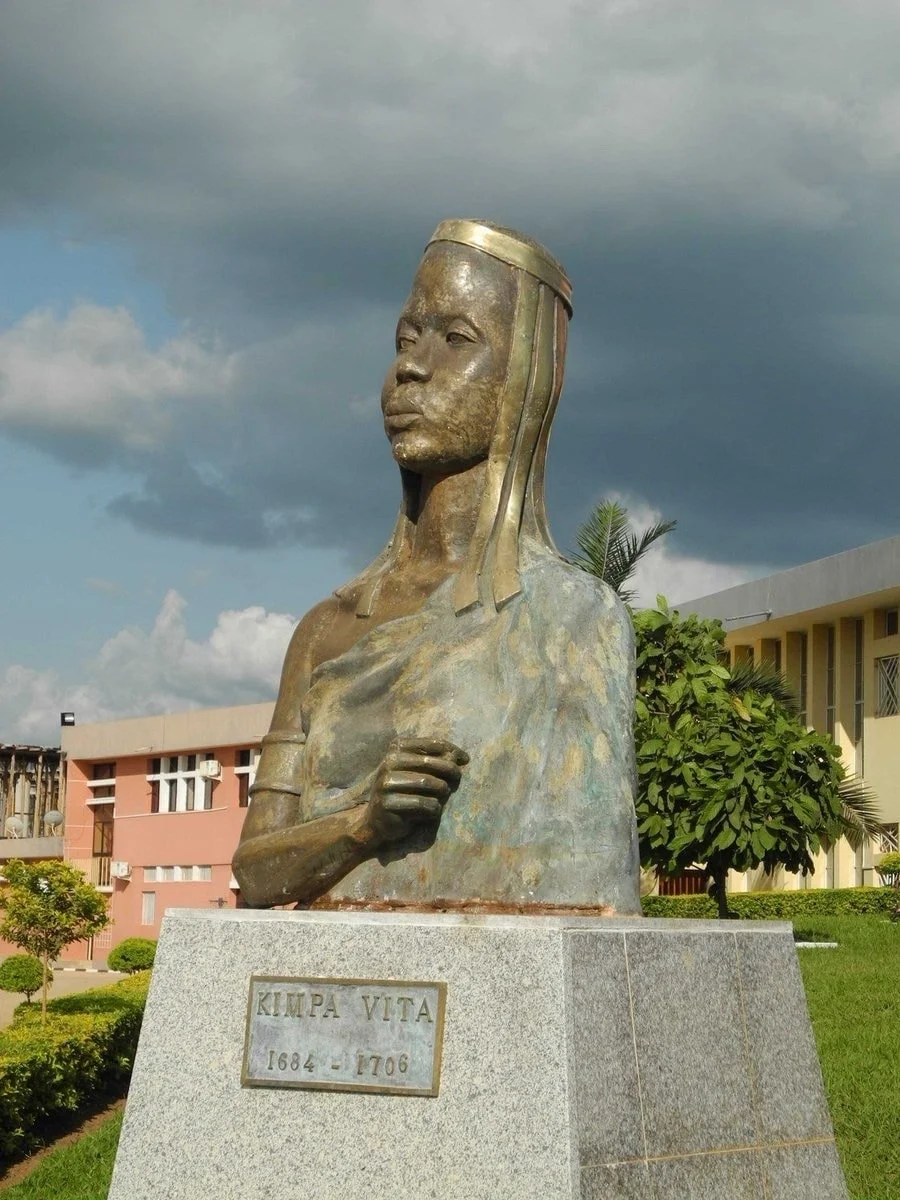
Kimpa Vita's statue in Angola (Uíge)
Dona Beatriz Kimpa Vita and the Little Anthonys (1684 - 1706)
“During the era of the slave trade, Kongolese notions of the soul maintained that the body existed as a container for a composite set of inhabiting souls, that, though independent, existed simultaneously in each person, animating the body and investing it with breath and life.” In other words, the body itself could be considered a minkisi, or container of spirits, and could hold the spirits of revered ancestors. According to Prof. Jason Young, “Africans in Kongo and slaves in the Lowcountry perceived minkisi, medicine bottles, and conjure bags, and in some cases, human being themselves-as mere vessels housing abiding animating spirits…[M]any Kongolese regarded Christ as a most powerful nkisi. Even more, the Kongolese had a long tradition of regarding their king as a great nkisi.” At the beginning of the 18th century, as the Carroll’s slave trading began to take off, Kimpa Vita and her “Little Anthonys,” as her followers were referred, fought a spiritual battle in the Kongo that resulted in her followers being sent abroad into slavery, very likely to the Carroll’s plantation in Maryland as one of their destinations.
Dona Beatriz Kimpa Vita became a nganga at a young age. A nganga was a Kongo spiritual healer, and the designation was given to people demonstrating spiritual or healing gifts. Sometimes ngangas were individuals with diseases that were perceived as giving them special abilities and insight. But even with this honorary distinction, Kimpa Vita was not the only prophetic Kongo voice of her time. She was, however, the most powerful. Her spiritual journey began when, as a child, she had a vision that two white children appeared and gave her gifts. In Congo pre-colonial spirituality whiteness symbolized otherworldliness, rather than the racial distinction of European people. Her childhood visions made her path toward adulthood an unusual one. Kimpa Vita was married twice, but not for long. Instead, she made a name for herself with her powerful, regal presence and sharp critiques of the occupying Catholics. Kimpa Vita was disturbed by the fact there were no black saints.
Once possessed by St. Anthony, he revealed to her a “truer” version of Catholicism that valued intention more than formal Catholic ritual. This focus on actions and intentions, rather than the formality of the Catholic ceremony, was very much ahead of her time and foresaw the Great Awakening in the colonies. Unique approaches to traditional Catholicism, and the Roman Church’s reactionary desire to maintain its power, were the intellectual backdrop of European colonialism and the Atlantic slave trade. And though Kimpa Vita’s Antonian movement was not respected by her European Protestant peers, she still had a profound impact on the New World.
By the time the English entered the mix in Western African slavery, the Kongo people had been Catholic for over a hundred years, and colonists in English North America were more likely to buy slaves in the Caribbean than off the Coast of Africa. Few North American slave owners purchased slaves from Africa. Instead, enslaved people were bought from the Caribbean, where various regions of Africa's Western and Central diaspora were organized to maximize profit. This meant that even though the English foray into slavery started in the Senegambia region, where the Portuguese had started two hundred years ago, they were getting most of their slaves second-hand from more established trading networks that began selling people from further South. Though English participation in the Atlantic slave trade started off thousands of miles north in Senegambia, the region formerly ruled by Mansa Musa, the Kongo also, not coincidentally, figured heavily into the Atlantic (and Chesapeake) slave trade up until the American Civil War and Kongolese people would have been available for sale. Kongo, now the DRC, Angola, and its neighboring nations adopted Catholicism when Nzinga Nkuwu became baptized Christian in 1491. By the late 17th century and the beginning of the 18th, Kongo, a once powerful nation, though not successfully conquered, was fractured and exploited by the Portuguese.
In the 18th century (1701-1800), the name Anthony was a battleground. The reincarnation of St. Anthony of Padua through Dona Beatriz Kimpa Vita, a Kongolese religious leader in the 1700s, was the manifestation of hundreds of years of colonial strife between Catholics and local Central African religious practices. Since the late 1400s, three hundred years before the Declaration of Independence was a twinkle in the founders’ eye, the Kongo people had taken Catholicism from the Portuguese and made it their own. Simultaneously, Europeans transformed African slavery into a more brutal version of their own. Dona Beatriz Kimpa Vita's spirituality became popular because it embodied the way traditional Kongo religion and Catholicism made something new. At the center of her brand of Catholicism was her criticism of the Church's lack of black saints. According to Dona B, Jesus was born in the royal city of Sao Salvador, not Bethlehem. For Dona B and her followers, Jesus was not baptized at Nazareth, but actually was born in the northern province of Nsundi, Jesus and Mary were actually Kongolese, and Mary's mother was a slave of the Marquis Nzimba Mpangi when Mary gave birth to Jesus.
Dona B’s radical 18th century reimagining of the Bible gained a vast and loyal following that threatened the occupying Catholic regime. This Kongolese prophetic Catholicism had a political message; along with openly critiquing the exploitative hypocrisy of the “politically neutral” Catholic priests and Capuchin monks, the “truer” version of Catholicism would re-unite the Kongo, Portuguese colonialism had fractured. While King João V of Portugal enjoyed the benefits of a wealthy, stable rule in Lisbon, the Kongo was being torn apart by European interests disguised as Catholic neutrality. Uniting the Kongo was tied philosophically to this truer vision of Catholicism, free from Roman deception and duplicity. Charles Carroll the Settler, brother of Anthony Carroll, reached its zenith a year before he died in 1720. Once Kimpa Vita was crucified by the occupying Portuguese Catholics in the early 1700s, the British inheritance of the West African slave trade followed close behind. The fall of the resurrected St. Anthony broke the British Royal Africa Company monopoly, and a record number of Congolese people came to the Caribbean, Brazil and the United States as slaves.
In Catholicism, especially in the 18th century, St. Anthony was an important figure. Born Fernando Martines Bulhoes, St. Anthony was a Catholic missionary at the end of the 12th century, three-hundred years before Portugal sought Western African gold, Bulhoes wanted to begin his work in Northern Africa, but due to illness failed to reach Morocco. Instead, he ministered to the poor in the Mediterranean. His desire to serve the Dark Continent foreshadowed his eminence in sainthood among the Kongolese people. And it also foreshadowed the ways the African diaspora, kidnapped and divested of their cultural and physical wealth, became something new. In the 18th century Caribbean and colonial North American shores, “in fusions of music and spirit, black women, children, and men from a motley array of homelands gathered information from each other about the place they now resided in and the places from which they had come. They constructed an epistemology, a way of understanding their being in the New World, and were not afraid to call the supernatural into being on their behalf.” Dona Beatriz Vita Kimpa’s possession by St. Anthony half a world away, within her African Catholic religious practice, presaged the ways black American spiritual leaders would embody their namesakes for the sake of liberation. Around the same time, Charles Carroll the Settler’s nephew James Carroll eschewed the humble life of his father, Anthony Carroll, to enjoy the fruits of African labor, but as an innovative slave trader. The Portuguese had become impatient with diplomacy and Jesus' mission, and eager to violently commandeer the country's rich supply of precious metals (copper, gold) and slaves. Considering the violent attempts at erasure of African religious practices, our ability to connect the spiritual practices of the enslaved to their antecedents in the Kongo is a testament to their strength, and also, proof that the enslaved people arrived on the American shores with a durable and robust spirituality already intact.
Some historians, including Prof. Young, believe that followers of Kimpa Vita were brought to the U.S. with a revolutionary zeal that accompanied and defined their already complex spirituality.
The enslaved Kongolese people brought to Florida ran away to Spanish Catholics, and those brought just north to South Carolina were resistant to white Christianity, despite their belief in Catholicism, and most likely started the Stono Rebellion. Even the Haitian Revolution can be traced to Kongolese descended people, using the same Kongolese combat tactics as the Stono Rebellion to overcome Napoleon's army and become the first independent black nation in the new world.
Kongo was “introduced” to Catholicism in the 15th century, long before the Carroll family had set foot in Maryland, and the religious conversion left the nation less inhabited and less wealthy. The people had been divided and to a great extent, divested of their wealth and cultural practices, as Europeans intensified the Atlantic slave trade. Three hundred years later, the now-ravaged Kongo people were still Catholic, but their version of Catholicism had evolved to be different from the Portuguese. Kongo leadership had been desirous of its own Church since before Alonso I (1506 - 1543), and when the Portuguese and Kongo went to war, the Kingdom of Kongo allied across religious loyalties with the Protestant Dutch, exemplifying the stark differences in religious allegiances, and styles of Catholicism. “Even as Christianity assumed increasing importance at court, Kongolese officials practiced it through their own cultural lens.” In the Kongo’s conquered and defeated 18th century version of itself, St. James the Moorkiller, beloved among the Portuguese and Kongo alike, seemed like a less appropriate patron saint than the Portuguese missionary to the poor, St Anthony of Padua.
Anthony Carroll (1660- 1724)
On the flip side, long before they owned any African-descended people, an Irish boy named Charles Carroll who would eventually be nicknamed "The Settler" in contrast with his brother Anthony, showed the difference a name could mean in the 17th and 18th centuries.
“As a younger son, might have been fostered out, a common custom of the time, to the more substantial home of his kinsman Richard Grace, who did not have a son. Two facts of Charles’s personal history point strongly in this direction. First Charles underwent a course of intensive schooling, but his older brother Anthony remained illiterate. Second, Charles not only attended institutions in France that ostensibly demanded far greater resources than those available to a head tenant, studying humanities and philosophy at Lille and civil and canon law at the University of Douai (both in France close to its northeast border with Belgium), but he also enrolled exclusively, since the Old English strongly preferred the Jesuits whereas the Gaelic Irish favored Dominicans and Franciscans.”
The Carroll brothers’ lives exemplified this sharp divergence, with Charles and his descendants maintaining a firm attachment to the Jesuits, and Anthony and his son Daniel choosing to be buried in the Dominican chapel at Lorrha in County Tupperary. The Old English and their association with Jesuits were considered “Irish-lite” by Gaelic Irish, who would never ally with the head of the Church of England. The Old English had allied with the Gaelic Irish people’s oppressors and therefore, were not true Irish. The Gaelic and Southern Irish associations with Dominicans and Franciscans are a working-class brand of Catholicism that catered to the poor and oppressed. The Settler’s branch of the Carroll family would reject these values wholeheartedly. Despite their reputation as pious Catholics, the Carrolls were not concerned with ministering to the poor unless it involved putting poor Irish and German people between them and their black slaves.
When CCS arrived in Maryland neither Baltimore nor Annapolis existed as a city. There were no cities of any size or significance and the capital St. Mary’s City was barely that. Carroll showed up to the Maryland shores with every advantage. Though he was born a Irish peasant, his adopted father’s connections to the royal Stuart family gave him critical connections and clout in the fledgling colony. He was educated at elite European institutions and awarded the post of attorney general in the proprietary government, a post that paid him $50 sterling a year when ordinary planters ranged from $10 to $15. In addition, lawyers and government officials, of which CCS was both, could make an additional $500 through other activities such as lending money, land and/or services, all of which the entrepreneurial CCS took part in.
The humble, Irish peasant tone of CCS biographies don’t match the facts. CCS had connections. He had a powerful office in the local government that paid him 5 times the earnings of an ordinary planter. The dominant narrative is that CCS was a victim of anti-Catholic sentiment but became a pillar of the religious freedoms upon which the United States was built and Catholic immigrants could rely to assimilate them into the New World. In terms of the history of Maryland, anti-Catholicism threatened to ruin the true intentions of both the Stuarts and Calverts of creating the Maryland colony with religious freedom for Catholics. However, “The Royal Africa Company of England shipped more enslaved African women, men and children to the Americas than any other single institution during the entire period of the transatlantic slave trade. From its foundation in 1672 to the early 1720s, the African Company transported close to 150,000 enslaved Africans, mostly to the British Caribbean.” But when the RAC disbanded, slavery in the United States was just getting started. No dollar amount can capture the brutality of the Middle Passage, Antebellum Slavery, and the Second Middle Passage of the domestic slave trade. It is hard to quantify the financial wealth stolen from African people, and the cultural and social capital destroyed generation after generation.
The dissolution of the RAC's monopoly related directly to Maryland's growth as a colony. Pettigrew argues "that the deregulation of the slave trade saved Maryland, in particular from ruin" because 'before opening the Trade to Africa [Maryland planters] owners of many 1000 Acres of good land, were obliged to work barefoot and barelegged in cultivating their own grounds themselves and were resolv'd to have deserted that Province, had they not been supplied with Negro Servants." The Carroll family not only owned brutal human trafficking operations that grew and intensified over nearly two hundred years, but they also suppressed the liberatory efforts and religious practices of the African-descended people they enslaved.
CCS owned and traded people before his death in 1720. By marrying advantageously, CCS would avoid having to ‘work barefoot and barefeleg’d” alongside tobacco planters or the enslaved, and being blackballed, by the suddenly anti-Catholic Maryland government.
Despite his ambitions or more likely because of them, CCS settled on a former white indentured servant, Martha Underwood, twice widowed and many years CCS’s senior, with four young children, for his first wife in the colony. Underwood had come to Maryland as an indentured servant in 1671 and married a prominent, Protestant attorney, and inherited his sizable wealth and two plantations as a result of his death in 1681.
Two years later, she married Anthony Underwood, himself a former indentured servant and law clerk of her first husband. Underwood began practicing law after completing his servitude and was steadily rising in Maryland society before his death in 1689 at the age of thirty. It was CCS’ marriage in 1689 to Martha Underwood, less than 6 months after the death of her last husband, that shielded CCS from the effects of the Protestant overthrow of the Catholic Calvert-run government that robbed him of his office and salary.
The Protestant Revolution that occurred that same year in Maryland was probably the greatest influence on the timing of the nuptials, besides the recent death of her last husband, Anthony. An Act to Settle the Trade to Africa in 1689 ended the Royal Africa Company the same year opening the floodgates for the expansion of the Atlantic Slave Trade. For white colonists looking to get in on the business and widen their margins on the traffic of human beings, this was great news. For people in the West African countries below Senegambia, this would mean disaster. Almost a year after their wedding, CCS's much older wife, Martha Underwood, died giving birth to a boy named Anthony, the name of her previous husband and CCS’s brother. Both mother and baby died three days after the birth. Martha's death timed up perfectly with the end of the Royal African Company monopoly. As the executor of her and her former husband's will, CCS had complete control of her estate. CCS would not stop with Martha’s estate but instead continue to position himself in society through strategic marriages. Three years later, CCS married again, this time even closer to the center of power in the colonies. In 1693, CCS married Mary Darnall, the 15-year-old daughter of Col. Henry Darnall. He made his first purchase of land within the confines of Annapolis, Maryland's new capital (having moved from St. Mary's City in 1694) on the Severn River in 1701. In the vacuum of the Royal Africa Company was an open market and a company with a bunch of slaves and a marketing problem, the RAC symbolized the old guard. Charles and Anthony's son, James, were in the perfect position to take advantage of this glut of slaves. Charles Carroll was in control of the real estate grants of Maryland, and in addition to buying and selling huge portions of Maryland land, he bought cheap slaves from the Royal Africa Company, put them to work, and leased and sold them to the Catholic laity.
By 1706, Carroll bought Lots 4 and 5 (on the Stoddert map of 1718) from Henry Ridgley, representing the current site of the Annapolis house. Of equal importance would be the acquisition in 1702 of a 7000-acre tract called “Doughoregan Manor'' (now in Howard County) which, along with the urban house site in Annapolis, would become the focal point of Carroll family life for the next four generations and the site of the University of Maryland’s archeological dig that uncovered the conjure caches. Through his marriage, Carroll inherited even more land in Anne Arundel County. Henry Darnall had also made CCS executor of his will before he died and gave CCS even more land in 1711. “In the decade between Darnall’s death and his own, CCS doubled the acreage he had acquired during his first two decades in the colony.” In addition to slaves and land, in May 1694, Darnall made Carroll the clerk of the Maryland land office, practically in control of all land transactions in the state.
Carroll became so powerful in the state of Maryland that even the man sent by the king to oust him, felt helpless and intimidated. The official treatment of Catholics in Maryland worsened, but Carroll would not be moved. Carroll had bullied Governor Seymour, a Calvert loyalist, into doing what he pleased but John Hart would prove a more difficult adversary.
“Governor Seymour’s successor, John Hart, remained in office for five years after the Calverts’ restoration and, like Seymour, believed Catholic plots were pervasive in the colony. It infuriated him that Carroll retained authority under the new proprietor. Indeed, after Darnall died, Carroll had fallen heir to (Lord) Baltimore's chief offices in the colony. Carroll's dispatch in collecting proprietary fees, fines, and taxes- and his refusal to take the Oath of Supremacy-pushed Hart over the edge." In addition to flagrantly wielding his immense power in his own interest, CCS made grand public gestures supporting the Stuarts and even hired a convicted murderer (his cousin and lawyer Thomas MacNamara) to harass Hart, to the point that Hart fled back to England in failing health.
Although a similar chronological calculation for CCS’s investment in slaves cannot be made because of missing documentation (a common theme), at his death, he owned 112, half of whom were working hands. Valued at £1931, Carroll’s slaves resided in the quarters of his five plantations, where they produced tobacco, wheat, and corn, and tended livestock…” By 1711, Carroll had more outstanding mortgage loans than anyone else in Maryland- a total of thirty, his nearest competitor was a legal client. Though we do not know the exact numbers for CCS’s involvement, his recorded slave trading and official business started as early as 1707, maybe earlier, with his nephew, James Carroll, son of his brother, Anthony.
St. James, The Moor-killer, James Carroll and the Other Anthony Carroll (1722-1794)
When Charles Carroll the Settler (or CCS) landed in Maryland, Dona Beatriz Kimpa Vita was four years old, and the name Anthony had and would figure greatly in his life. Firstly, Anthony was the name of his older and less fortunate brother. CCS was the younger of two sons and the only son who was fostered out to a family friend on the other side of the Irish Catholic beef with Great Britain than his biological family. Richard Grace was a childless but respected member of the Stuart court, and as an Old English Jesuit as opposed to a Irish Gaelic, he had a profound impact on Charles Carroll the Settler's life. "Charles underwent a course of intensive schooling, but his older brother, Anthony, remained illiterate. Charles not only attended institutions in France that ostensibly demanded far greater resources than those available to a head tenant, studying humanities and philosophy at Lille and civil and canon law at the University of Douai. But he also enrolled exclusively in institutions operated by the Society of Jesus, the Jesuits. Here Richard Grace's influence is unmistakable, since the Old English strongly preferred the Jesuits, whereas the Gaelic Irish favored Dominicans and Franciscans." St. Anthony was a Franciscan. Dominicans and Franciscans ministered to the poor. The Jesuits, on the other hand, were the ministry to the wealthy, educated, and morally flexible. CCS's brother Anthony had a son named James who would become a priest, and die wealthier than his father could have ever imagined. James Carroll certainly lived up to the saint with whom he shared a name, Matamoro or St. James the Moor-killer, by creating the foundations for slavery in Maryland, and by extension the United States. Many black people would be murdered, sold, and dehumanized at his hand. James Carroll served as CCS's Jesuit consigliere in his successful foray into slave trading.
In his study of the Jesuit priest, biographer Charles M Flanagan observed that James Carroll, son of Anthony Carroll, and Charles Carroll the Settler’s nephew, owned a great number of books for an 18th century planter, but not very many books for a scholar by today’s standard. One of those books was The Life of St. Anthony.
According to Flanagan, “Carroll’s owning The Life of St. Anthony reinforces the ascetic, contemplative theme. This fourth-century work by Athanasius describes the choice of the saint to renounce the world in favor of a life of solitary prayer. In the desert, [St.] Anthony wrestled with devils in various forms, representing the temptations of the world, and espoused a life of constant prayer as the only true refuge of the soul. Carroll’s copy of this classic work was in French, raising the question of whether he acquired the book when studying in Europe. It is attractive to view his ownership of this volume as evidence that his education for the clergy was interrupted by the Irish wars and that his work in Maryland was a voluntary exile from Ireland in which he acted publicly to restore his family’s fortune but privately to preserve his own soul.” This passage from Flanagan implies that James Carroll has a moral conscience, but James Carroll was no saint. James Carroll did not wrestle with temptation, he embraced it. The Catholic priest innovated in slave/tobacco trading by verticalizing the operation from top to bottom, in addition to violating oaths of celibacy to the Church, he also violated oaths to his enslaved mistress for her and their children’s freedom (which evolved into Supreme Court Case Hepburn v. Queen).
In 1720, the year of CCCs death, administrators of his will brought suits on behalf of his estate for debts amounting to £2,200 ($500k). CCS died with £7535 ($1,731,128.33) in non-land assets, his total worth around £30,000 ($2M), an unimaginable amount of wealth at the time. But the dollar amount does not quantify the value of Lots 6, 7, and 8, which were acquired in Annapolis in 1717 and would develop into the house and gardens in the latter half of the 18th century, Annapolis House, on the prime plot of land in Annapolis, much of which is the US Naval Academy grounds now. CCS had come to Maryland as an attorney general in the proprietary government guaranteed 50 pounds a year.
When he died in 1720, he was banned from public office for being Catholic but was already considered Maryland's wealthiest and largest landowner.
He had survived the local Protestants’ attempts to strip him of wealth and had multiplied it many times over. But forgotten in the telling of this narrative are the enslaved people that made this possible. CCS was at the center of all the land transactions, but as Pettigrew says, the land was worthless without the African laborers kidnapped to labor on it. Perhaps not coincidentally 1720 was the year the greatest number of people were traded from the Congo into the Atlantic slave trade.
At CCS’ death, “James Carroll served as a patron for younger relatives in his last decade, and he actively groomed chosen young men for leadership roles. For his nephew and CCS’ heir, Charles Carroll of Annapolis, this amounted to a decade of mentoring in commerce (mostly in slaves).
For his Irish nephew, Anthony Carroll, this meant financing a Jesuit education that led to a career as a priest and philosopher.” James' mentorship had a profound impact on both CCA and Anthony. But it is significant that in making his nephew, Anthony, his heir, he was concerned more about salvation and worthiness than about wealth: "James Carroll was determined that he would not invest his money in an unworthy heir, or see his wealth spent on the ordinary things of a Maryland planter or Irish farmer's life. His exacting standards were expressed in a series of conditions he imposed on his beneficiary. Although he named his nephew, Anthony, as his heir, he took steps to ensure that his kinsman was worthy. He stipulated that: “In case my nephew shall die or prove unreceptive to learning or prove incorrigible or want application in any of the courses before he attains twenty-one years of age, then it is my will and I do require my executors to discontinue the application of money to his education. Or if he proves vicious also to discontinue.” The last sentence of this set of conditions separated intellectual talent and discipline from moral character. The moral condition was added as a thought considered after a pause.
In his mentorship of Charles, moral character was not as central a tenant of his mentorship.Both James and CCA would sell their own bastard children with African descended women into slavery.
Later on after both James and CCS’ death, Charles Carroll of Annapolis left his cousin, Anthony, in charge of his only claimed white bastard son, CCC’s, schooling, and when the boy was sent away to St. Omer, like CCA and James, Anthony played the role of instructor and father figure. There is no mention of Anthony Carroll in Ronald Hoffman’s family biography.
Though he may have had more education, more resources and more social acceptance than his great uncle Anthony Carroll of Lisheenboy and Dona Beatriz Kimpa Vida, his fate was similarly gruesome. On September 5th he was knocked down and robbed in Red Lion Court, Fleet St., London and died at St. Bartholomew's Hospital at 1 A. M. next day in 1794.
Moses > Anthony
At the beginning of the century in 1704, two years after CCA was born, and around the time CCS' slave empire was taking off, a Kongo woman was burned at the stake for leading a movement in the name of St. Anthony. Her followers were sold into slavery and likely part of the community that made up Charles Carroll the Settler’s early slave empire.
And like the "Little Anthonys," the enslaved people on Carroll plantations in Maryland blended West African conjure and possession practices with Catholic indoctrination to make a new system that was both a sustaining combination of Christianity and magic, but also a critique of the mediated emptiness of white Christianity.
Instead of Saint Anthony, the people of the United States focused on Moses. Perhaps because Moses had succeeded where Anthony had failed. Perhaps because Moses spoke more clearly to the Diaspora that included the enslaved community in North America, as opposed to just the Dona Beatriz followers of the Kongo.
For Prof. Theophus Smith, the focus on Moses as the center of African American religious life originated in Africa, and the ways that conjure was practiced in Western Africa survived in the United States through the veneration of Moses as the God-Conjurer.

“For their part, the means employed by the ritual experts for achieving the ancestors' vision of a perfect cosmos is talismanic, pharmacopeia, and divinatory; consisting, that is, in the use of minkisi as charms or medicinal and divination instruments. In this regard, we may represent the black North American folk version of Moses on the model of a Bakongo ritual expert (nganga), who employs a combination of charms, medicines, and divination to realize an ideal world as envisioned by the ancestors and as represented in cosmograms.”

Moses served as the model of the most powerful magician the universe had ever known and for those kidnapped and thrown into the holding cells on the Western Coast of Africa that required a liberating force that could overcome an earth-bound force determined to profit greatly from their capture, Moses symbolized potential freedom. "Through dance and song, [the enslaved] beseeched spirits and deities for favor, protection, and restitution. They encouraged ancestors to speak across time and space by using those in attendance- by possessing them." Whether they were Sengambians brought from the land of Mansa Musa, or Kongo Catholics brought from Angola, the people brought to the Chesapeake as slaves came with a robust religious practice that had already wrestled with the emptiness of European Christianity and its transactional nature.
In a sense, Charles Carroll, the settler, born in Ireland in 1661, and the Royal African Company are Irish twins.
Charles Carroll the Settler (1661–1720) and his Irish twin, the Royal Africa Company or RAC.
The two were raised together and equally influenced by the Stuart agenda to reestablish monarchical dominance. CCS married for the first time at the same time that the RAC lost its monopoly, and he subsequently built his empire on an industry the RAC had created. CCS even died at the same time the RAC disbanded, but not before laying a foundation for his son to benefit greatly from the spread of the institution. The Royal Africa Company was like CCS's perpetual Giving tree, as depicted in Shel Silverstein's illustrated children's stories, only it was the people enslaved by the RAC from whom CCS would "procure" and sustain his wealth.
The Carroll family and The Maryland Society of Jesuits were the missing links between the Portuguese conflict with Kongo and the acres of fertile land in North America on which they were to become profitable, how it populated the Atlantic slave trade with “Little Anthonys” and where they ended up.
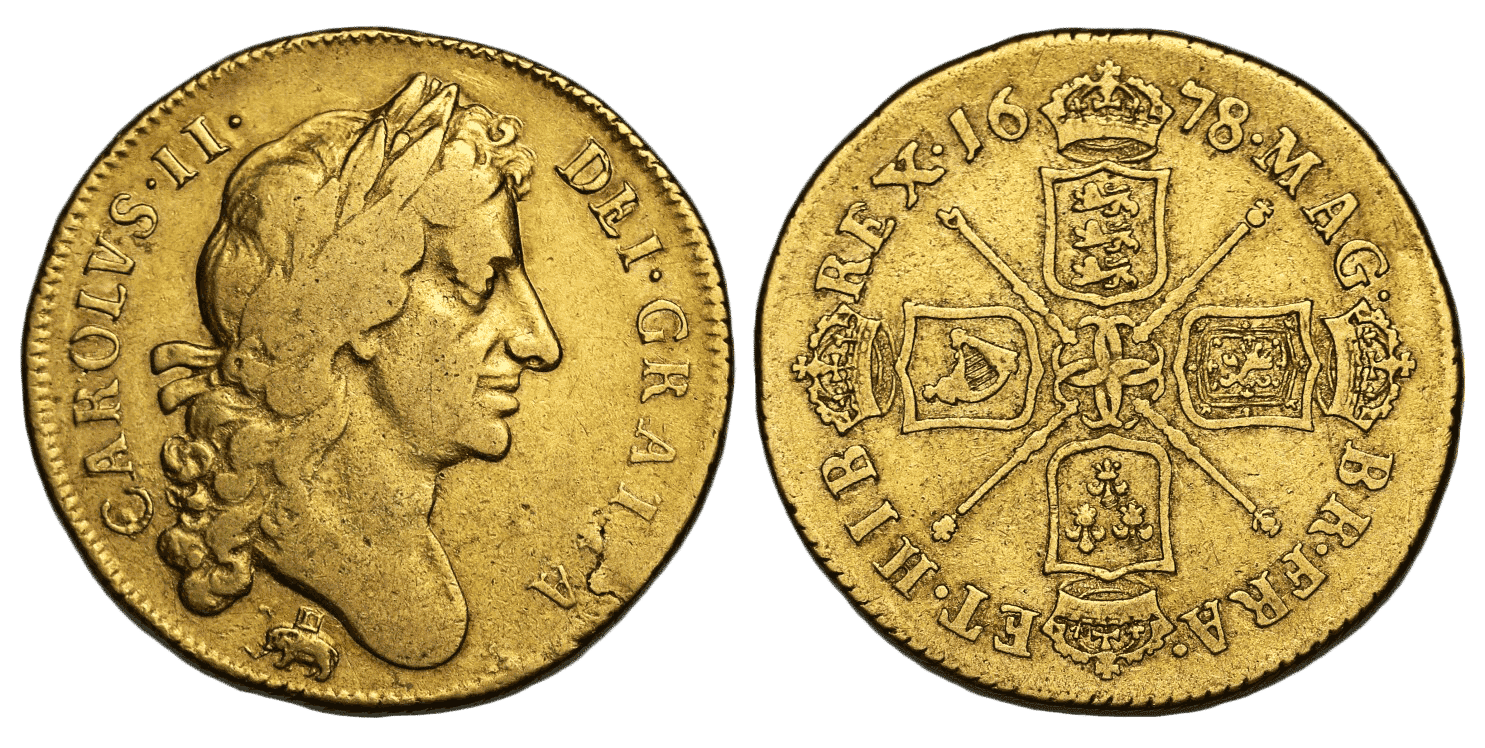
The Gold Guinea was introduced in 1663 during the reign of King Charles II. Struck in 22-carat gold, its name originated from the Guinea region in West Africa, where the raw gold was sourced. It remains highly sought after by collectors of British milled coinage.
Though the English were late to the Atlantic slave trade party, the Stuart’s Catholic ties made good for something in establishing the RAC’s roots in Africa. The English did not reinvent the wheel but adopted the ports at and off the coast of Western Africa as their own. To Western Europeans, and particularly British colonialists participating in the Atlantic slave trade, the RAC was the enemy of liberty, not in the ways that Africans enslaved by them viewed the RAC as the enemy of liberty, but because RAC held a monopoly that limited the upside of the slave trading industry. Traders made money by squeezing the margins on their human cargoes' humanity.
If only they were allowed to trade as many slaves as they wanted.
With protection from the internationally dominant British Navy and the benefit of distance from the homeland, nobody was more at liberty to buy and trade slaves than British colonists, but they wanted more.
As slave trading went private, and the Stuart's original foundation was overtaken by free trade, many forgot the role the Stuarts played in the genesis of English participation in slavery and how much they had been allowed to continue to profit. Benjamin Franklin and Thomas Jefferson would not forget, and both men wanted a visual comparison of Charles Stuart I as the Biblical Pharaoh on the United States national seal.
But as the founders of our country were seeing themselves as Moses to their respective European nations, they created hundreds of black Moseses from Western Africa who saw the founders and their fellow countrymen as Pharaoh and his soldiers. Both Jefferson and Franklin failed to deliver on Jefferson's penned promise of liberty and justice for all. And while the American financial landscape saw the black bodies as soulless commodities, many black people saw themselves as sacred vessels of their divinely inspired ancestors. Contrary to Franklin and Jefferson’s scapegoating aspirations, the Atlantic slave trade was inspired not by King Charles I of England, but by a black King named Moses