Chapter 5: Declarations of Dependence
V. Declarations of Dependence: Runaway Ads
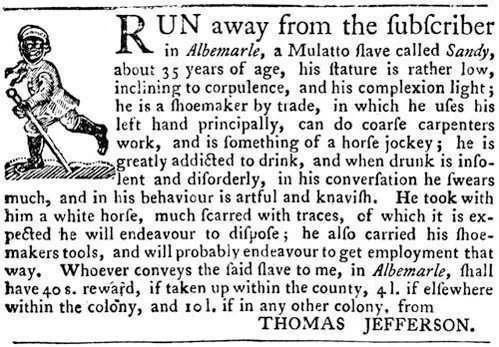
Thomas Jefferson Runaway Ad, 1769
When Thomas Jefferson wrote the Declaration of Independence, he understood the document’s central irony. Only seven years earlier, he had written a document that was the antithesis of the Declaration of Independence. It was a runaway ad or declaration of his financial dependence on the labor of the black people he enslaved.
Before Thomas Jefferson wrote the Declaration of Independence to the King of England, he was publishing declarations of dependence in the local newspaper.
1769 was a big year for Jefferson, not only because he was a freak (s/o to ally my freaks), he was, but also because he was in debt. It was the year he joined? The Virginia bar, big spending on Monticello.
The year Jefferson published the runaway ad was a year that Jefferson especially couldn’t afford to have any of his assets run away.
Especially one who was a valuable and skilled worker. Sandy, described as a mulatto in the ad, is also a skilled shoemaker, carpenter, and horse jockey.
It is from this state of mind that he wrote the portion of the Declaration of Independence that was eventually omitted. Jefferson feared that after the US’s founders rose against the British government, the enslaved black population of the colonies would do the same to them. To a certain extent, he was right. Jefferson was a francophile and by the end of the 18th century, a slave nation ruled by the same empire that endured the French Revolution would create an independent black nation run by formerly enslaved people.
Almost as soon as the French Revolution began to wrap things up, the French Caribbean nation of Santo Domingo fought for its independence from France, defeated Napoleon’s army, and became the black nation of Haiti.
The other founders must have been equally afraid of this outcome or believed in the power of writing things into existence, evidenced by the portion being taken out of the final document. Jefferson was afraid that one day he would be murdered by disgruntled black slaves. Throughout the Declaration of Independence are the themes of the unalienable rights of man, government by the consent of the governed, and the right of revolution against tyranny. However, the founders intended these concepts to apply only to landholding white men.
Though manumission (freedom) certificates and slave passes were the closest things that black bodies had to declarations of independence, yet these documents were only as credible as the white men who signed them. Slave ads were the inverse of manumission certificates or declarations of independence. Though they were created to terrorize and make property of humans fleeing for their lives and freedom, they could also be interpreted as declarations of dependence. Running away (in action) symbolized enslaved people’s rejection of their dependence on their master, while slave runaway ads demonstrated the master’s economic (at minimum) dependence on the return of the slave to the plantation. It is important that our founders declared independence from the English crown, seeing themselves as slaves to the King, while simultaneously declaring their dependence on enslaved labor in public documents. And one has to wonder how much Thomas Jefferson’s life among the people he enslaved influenced the tone of the document. Did Thomas Jefferson usurp the struggle of the black people he enslaved? Was he attempting to write from their point of view? Is this why he was so concerned about a black insurrection?
For Charles Carroll of Carrollton, Jefferson himself was a revolutionary who could not be trusted to run the United States government. For CCC, a country run by Jefferson was sure to result in the same revolutions that had overcome France and Santo Domingo, though neither of these had occurred when the Declaration of Independence was written.
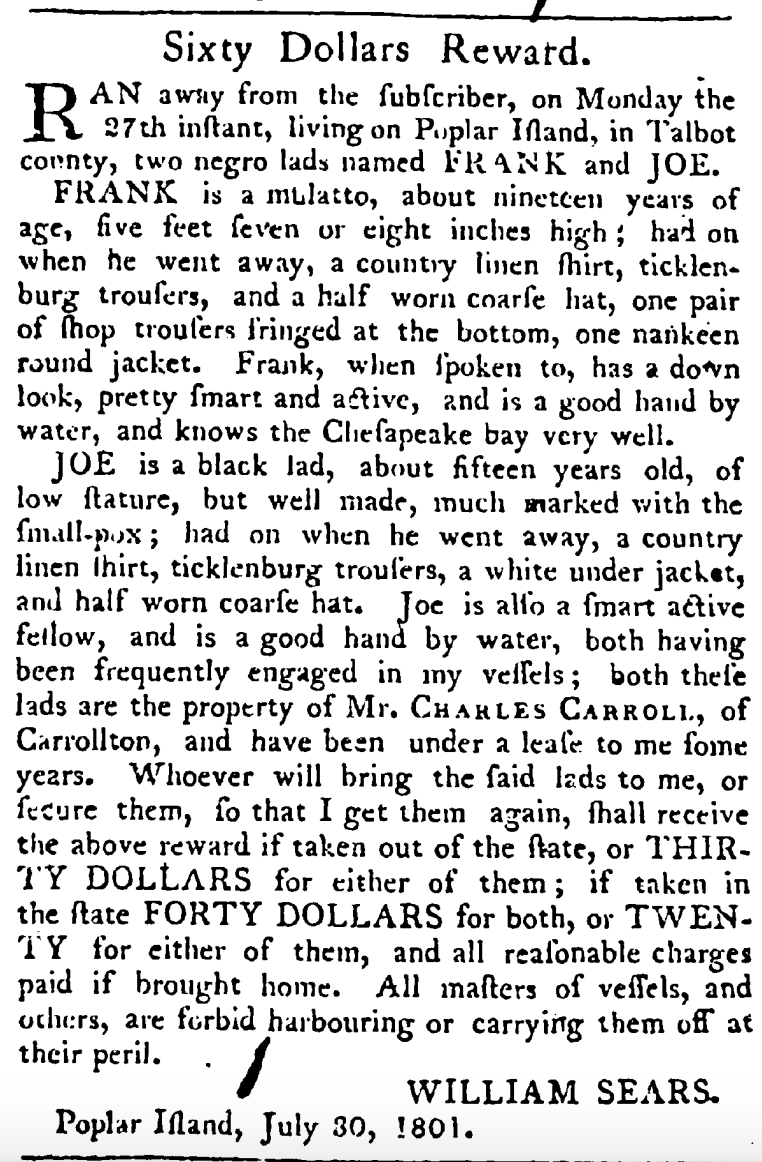
1801 Runaway Ad
In this chapter, we look at runaway ads and freedom suits, and where they overlap. In other words, there were slaveholding men who put out runaway ads for enslaved people that had been freed by the courts. Even the law couldn’t protect the formerly enslaved from terrorism. Runaway ads never existed without a social and financial context.
In this chapter, we will discuss some especially meaningful runaway ads, and the role names, along with actual escape, were tools of the enslaved to become free and to remain free. We will also examine how the runaway ads and the Carroll's political manipulation were complimentary forces that sought to transform those sympathetic to the plight of the enslaved to enthusiastic supporters of slavery.
Many enslaved families sued the Carrolls indirectly for their freedom, and many individuals won. Each victory by the enslaved people was a financial loss for the slaveholding class of Maryland, Carroll, and the Jesuit Corporation he indirectly controlled. However, many slaveholding white men fought victoriously in court against the freedom suits, and slavery would continue to exist for another 50 years after most of the suits were concluded. Carroll did not let white men advocate for enslaved people in Maryland, especially if they were successful. Under CCC’s influence, those who might have started out taking the righteous path of helping enslaved people escape bondage quickly switched sides. Such was the influence of the runaway ads themselves, which used racist and derogatory language combined with financial incentive to dehumanize courageous seekers of liberty. However, despite the terrorizing and degrading content of the ads, runaway ads could not erase the spiritual and symbolic power of names like Moses, which told a deeper story of faith, kinship, and freedom that refused to be silenced.
Wherever There Be Freedom
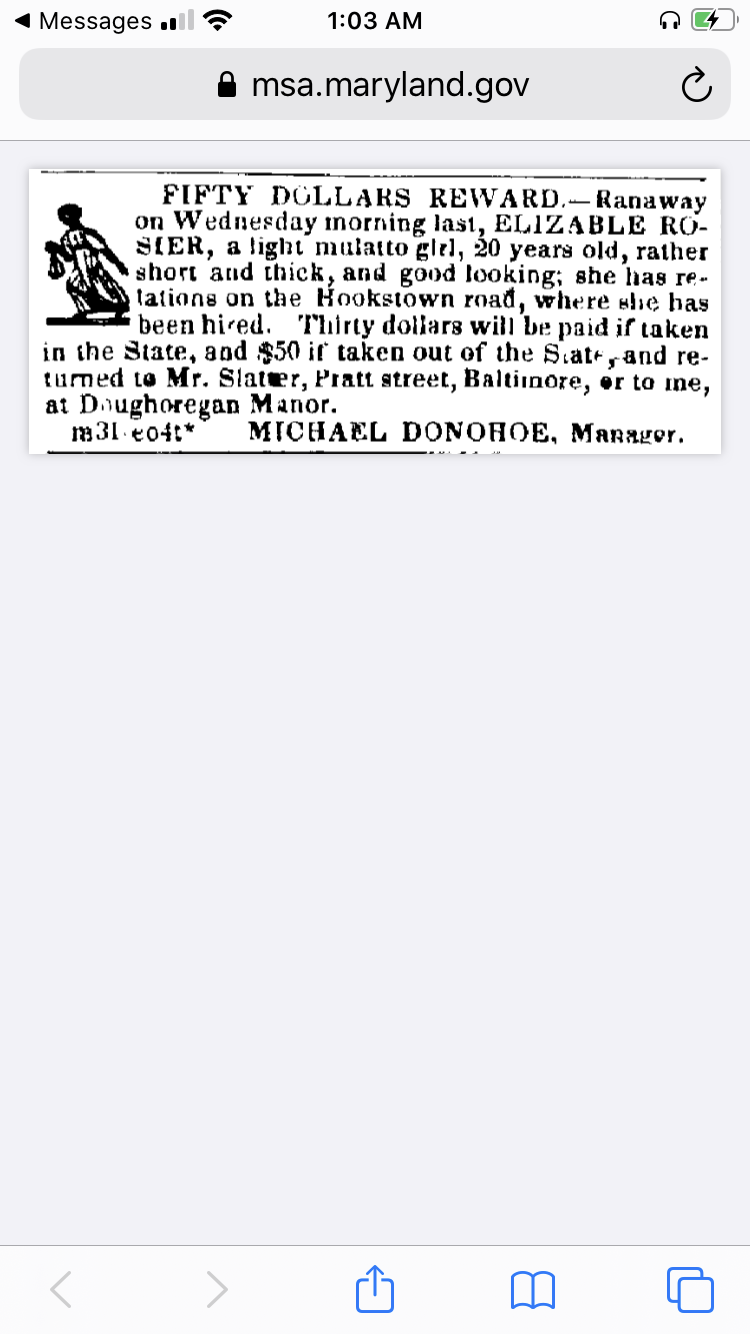
A runaway ad indirectly associated with Carrolls
Runaway ads turned ordinary citizens into slave traders. When an individual reported or captured runaways, they were given an economic opportunity that slavery had deprived them of. People who might otherwise sympathize with the liberatory aspirations of the runaway were enticed economically and socially to become members of the white ruling class. Many black people, both enslaved and free, participated in the practice as well, which spoke to the ads’ persuasive power. However, the ads were not effective in isolation. Instead, the ads reflected the attitudes and aspirations of the American colonists who had left Europe to escape their own degradation and entrenched feudal order. Acting on runaway ads, even in attitude, allowed them to take part in the plantation economic system which they would otherwise be excluded from.
Thomas MacNamera was a thug. Not in the Tupac Shakur way or the Trick Daddy way. But in the 18th-century mid-Atlantic slave trader way. He was biting off mfers ears. He was threatening and intimidating the most powerful officers of the crown in colonial Maryland. What the record does show is that Thomas MacNamera views on slavery were transformed by the Carrolls. MacNamera arrived in Maryland in the Spring of 1703 as a redemptioner bound to CCS. Redemptioner was a term for an indentured servant whose voyage to the colony was sponsored by the holder of the indenture, and whose service was owed to that person for a determined amount of the time. MacNamera was a lawyer and one year after his arrival to Maryland, MacNamera was acquitted of biting another man’s ear off, a statement to both his capability of violence and legal prowess. One biographer, C. Ashley Efferson, argues that MacNamera arrived to the colonies determined to do good. CLARIFY SHOW EFFERSON SLAVE CASES??? He might have been aware of his status as an indentured servant when he took up the cases of those he was responsible for freeing. But whatever instincts he had towards liberty were soon put out by his service to the Carrolls.
In 1714 Macnamera made sure that liberated mulatto Mingo Lewis was enslaved for life, in an appeal made after Lewis had won his case in provisional court. Mingo Lewis had a white mother and a black father, something that was rare in the colonies, but more pervasive in Maryland than mainstream American history acknowledges. Because slavery was maternal, or inherited through the mother, formally called partus sequitur ventrem, the offspring follows the womb, Mingo Lewis was legally free. But in Maryland up until the end of the Civil War, and some would argue after, being legally free did not guarantee your freedom as a black person. Ask Solomon Northrup, the famous protagonist of 12 Years a Slave, who was illegally kidnapped in Washington DC 130 years later, despite being free.
Mingo Lewis wasn’t the last person that Macnamera would torment.
However, the Mingo Lewis case reveals the tactics employed by the Carrolls and their lawyers to either re-enslave individuals deemed free by law or prevent them from being free in the first place.
How the Irish Became White
Thomas McNamera, presaged John Ashton, Philip Barton Key and Francis Scott Key in the ways he was corrupted by Carroll’s human trafficking agenda. Their lives mirrored that of the Charles Carroll’s who they all served. Like Carrollton, born a bastard, … They became white men by enslaving black people. Folks who may have been social outcasts, could use their oppression of black people as a way to be in the club. Runaway ads were the material embodiment of this practice.
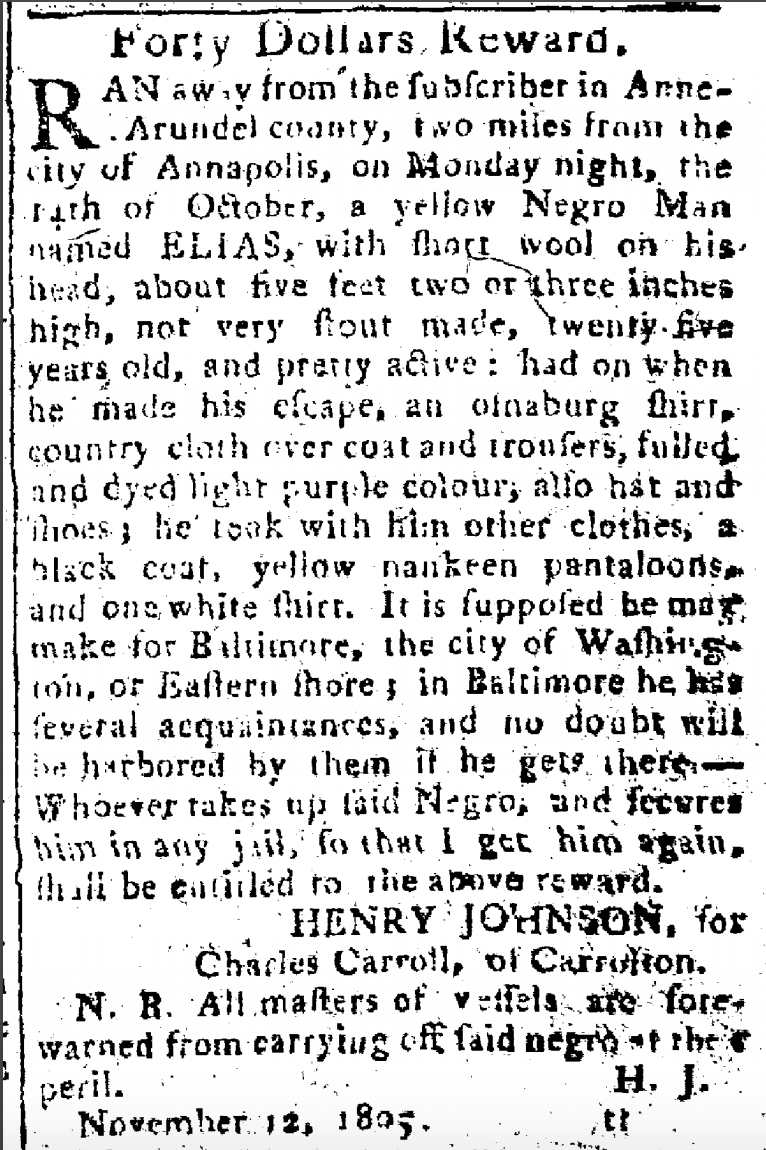
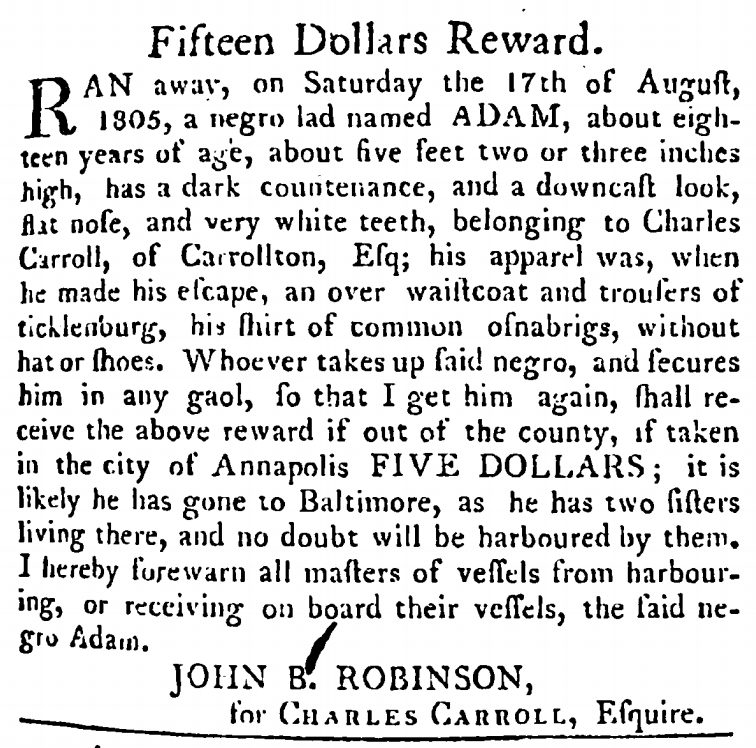
1805 runaway ad
So too were ordinary Americans corrupted, runaway slave ads trained readers to see bondage as normal, fugitives as thieves, and Black resistance as criminal, warping the public conscience in service of slaveholding power.
John Ashton was an Irish-born priest who had been educated alongside his cousins John and Charles Carroll of Carrollton. Like McNamera, Ashton came to the colonies at the behest of the Carrolls. And like McNamera, Ashton would slowly become corrupted by his involvement in slavery. He began to undertake the activity of making black Marylanders who should have been free according to the law, slaves for life. Both Ashton and MacNamera became the public face of Carroll’s misdeeds until their deaths. McNamera's life in the colonies was short, he served CCS and CCA, and he died only 15 years after coming to Maryland. But despite being a priest, and not a lawyer, John Ashton likely appeared in court on behalf of the Carrolls more than MacNamera.
Though in his typical apologist tone, Hoffman, referring to CCA and CCC as “Papa and Charley,” says the two “kept their distance with regard to the spiritual content of their slaves’ lives: there is no evidence that they ever sought to encourage Catholic conversion or Christian morality in any form. Their chaplain and cousin from Ireland, Father John Ashton, took a very different view and at one point complained incessantly to CCC that William Sears, the Poplar Island overseer, had become “intimately involved with Henny, a female slave who lived with her husband and children under Sear’s supervision. CCC found Ashton’s “interference unwarranted and exceedingly inconvenient.” Intimately involved is code for rape. The situation is an impossible one for Henny, the victim. Removing Henny from the island quarters meant she would be separated from her family, including her husband and children, but staying at Poplar Island meant continued abuse. Despite the cycle of terrorism and sexual violence in which Henny was trapped, CCC focused on, in his letters to Ashton, “the trouble of finding another ‘good house wench to replace her, ' although he acknowledged that ‘the crime of adultery is certainly great.”
This small tidbit might lead you to think that Rev. John Ashton is a reasonable man. This is far from the case. Rev. John Ashton’s relative morality only gives context to CCCs complete moral bankruptcy.
Throughout my research, I am continuously shocked that the possibility of CCC’s absolute cruelty is not a more considered interpretation of his behavior towards black people and the working class. CCC shows no empathy for Henny, a likely relative and, at the very least, a valued slave. Hoffman’s insistence that the Carrolls had no interest in the religious practices of enslaved people is absolutely ludicrous. CCC and his father were, along with the Society of Jesuits, Ashton’s main benefactors in his ambitions to expand the Jesuit stake in slave trading. Some of the enslaved people fought back in a way that many contemporary US citizens don’t realize was possible. They fought Ashton and the Carrolls in the court system, suing the men for their freedom as early as 1790. But even the courts fell victim to the Carroll's manipulation.
Runaway ads had the same effect as the way money and prestige overcame these men’s desire for liberty for themselves and others.
The way that Carroll’s money and influence changed the minds of previous liberators, to those who sought to enforce radicalized slavery, was codified in the slave ad. Those sympathetic to the cause of the enslaved or found themselves conflicted by their love of liberty was likely to at least pause at the opportunity for the reward of the runaway ad. The ads not only gave opportunity to collect a “lost” asset but also to create a racialized class division, where poor whites and free blacks, whose values might align more with the enslaved, could benefit financially from black slavery when they might otherwise benefit from its destruction.
Moses b. 1788 and Isaac b. 1746
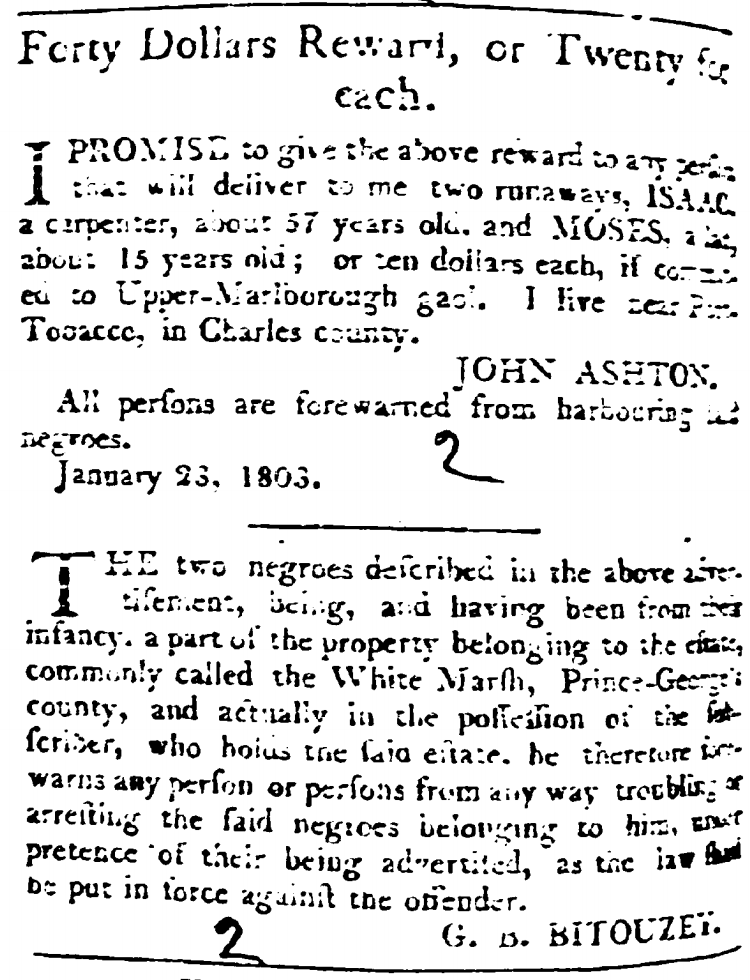
John Ashton and Jesuit Society competing runaway ads.
John Ashton weaponized runaway ads because he was losing control.
In 1803, Moses and Isaac, son and father, ran away from White Marsh Plantation, a plantation run by Jesuit priest John Ashton. By now Ashton had become fully indoctrinated as a slave trader. Isaac, presumably Moses’ father, is 57, and Moses is 15. The ad threatens any persons who help these runaways escape. This runaway ad above was placed on behalf of John Ashton, a defrocked Catholic priest and co-founder of Georgetown University. Though we saw what looked like his concern for Henny while ministering CCC’s enslaved people on Poplar Island, Ashton fathered several children with enslaved women and was sued by many enslaved people who were wrongfully enslaved by him despite having legal rights to freedom.
What does it mean for a Roman Catholic priest to publicly announce his desire to regain possession of a runaway slave named Moses, a 15-year-old-boy no less? According to William G. Thomas, John Ashton created these ads as a political maneuver to pressure the Jesuits into supporting his claim over these people to the property and control of White Marsh which had been put in jeopardy by his open, child-producing relationships with enslaved women. Runaway ads were always political, but especially with a runaway named Moses involved, it implied that the owner of Moses was the villain of the Old Testament. If the enslaved runaway is named Moses, his captor must be Pharaoh. When John Ashton posted these ads he was proudly playing the heel. Ashton chose intentionally to make the ad public as a way to pressure the Jesuit corporation into paying for Ashtons “retirement, as well as principal interest on various loans and reimbursement for all of the lawyers’ fees he had incurred at White Marsh.” Ashton is saying, ‘give me what I want or I am going to expose what we are doing.’ This ad is the physical representation of this demand. For Thomas, “[t]he ad was little more than a brazen public announcement that he was taking White Marsh’s enslaved property. Reverend Germain Barnaby Bitouzey, who had replaced Ashton as manager of White Marsh, places a rival ad in the same paper directly under Ashton’s ad “clarifying that Isaac and Moses were part of the ‘the estate commonly called White Marsh” and actually the possession of [him] as its manager. He called Ashton’s advertisement a ‘pretense,’ warning anyone against attempting to arrest or detain the alleged fugitives based on Ashton’s ad. In both cases, these men seem desperate to regain the two runaways, desperate enough to place embarrassing, publicly feuding ads. Both Ashton and the Jesuit Corporation were financially dependent on retaining these assets.
CCC, John Carroll, and John Ashton were first cousins and were educated together in Europe. Though both Carrolls were embarrassed by the fact that Ashton flaunted his alleged mulatto son, Charles, with an enslaved woman, Susanna or Sukey Queen, as his servant, they were hesitant to distance themselves from his money making operation, preferring instead to remove Ashton as head of White Marsh, and keep the profitable human trafficking operation for the benefit of themselves and the Society. The same John Ashton who had been so concerned with the enslaved woman being sexually assaulted by her overseer, had come to embrace the practice with enthusiasm.
John Ashton sought to intentionally embarrass the Carrolls as a means of maintaining control over White Marsh and its close satellite plantations, and to blackmail them into paying for his retirement or allowing him to remain in control. CCC was probably conflicted about whether to get involved, and to what extent. If they placed their own names on the ads, they might get the enslaved people returned but would make a public message. But then again, there is evidence that CCC cared very little that people knew that he owned people named Moses, and the resultant religious implications. CCC was proud to be pharaoh.
Moses and THE QUEENS
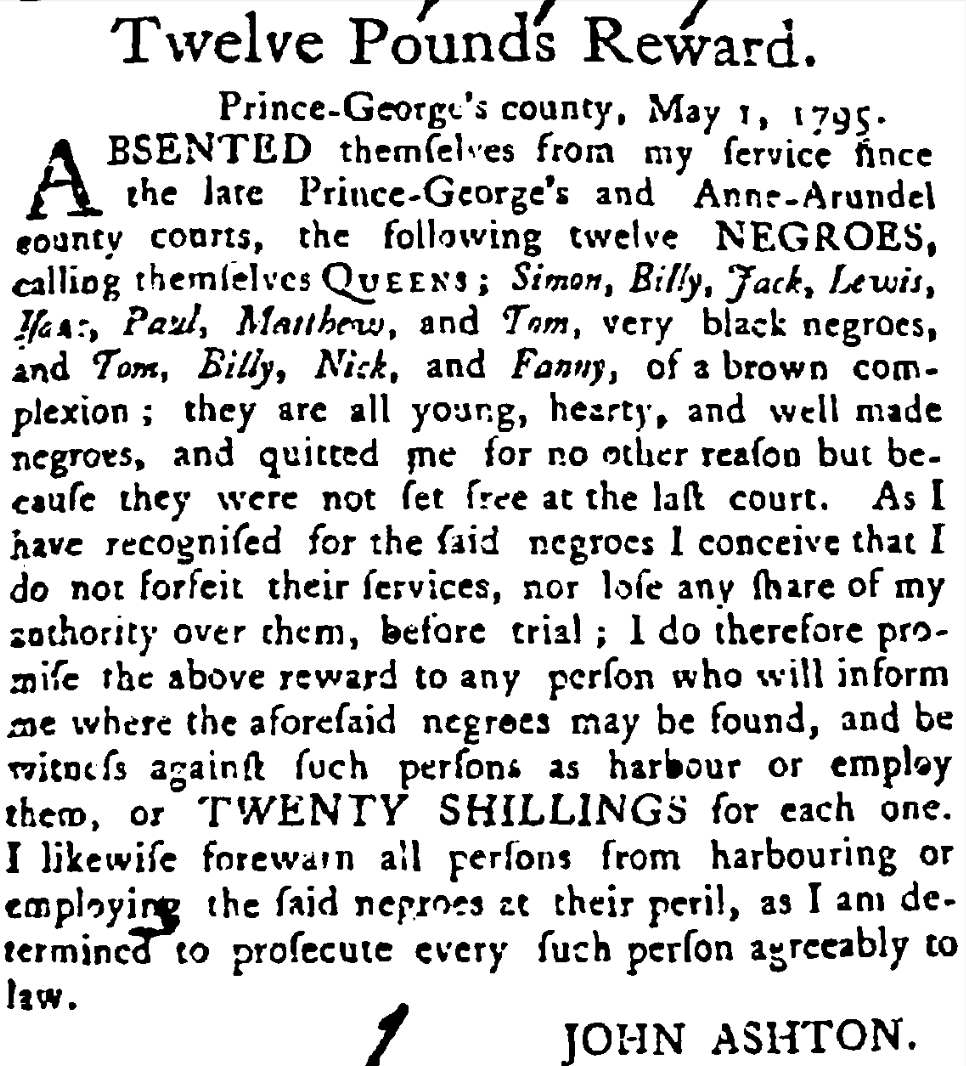
Queens Runaway Ad
Absented themselves from my service since the late Prince George’s and Anne Arundel county courts, the following twelve NEGROES, Isaac, Paul, Matthew and Tom, very black negroes, and Tom, Billy, Nick and Fanny, of a brown complexion; they are all young, hearty, and well made negroes, and quitted me for no other reason but because they were not set free at the last court. As I have recognized for the said negroes I conceive that I do not forfeit their services, nor lose any share of my authority over them, before trial; I do therefore promise the above reward to any person who will inform me where the aforesaid negroes may be found, and be witness against such person as harbour or employ them, or TWENTY SHILLINGS for each one. I likewise forewarn all persons from harbouring or employing the said negroes at their peril, as I am determined to prosecute every such person agreeably to law. JOHN ASHTON
The tone of John Ashton’s runaway ad for the escaped Queens is again one of desperation. John Ashton’s enslaved concubine was also named Queen, came from a family that had used their name to protest the status of their enslavement for nearly a hundred years. Susanna Queen’s last name came from a woman named Mary Queen. Edward Queen, Sukey’s (Susanna) uncle, was the first to sue John Ashton for his freedom. “Edward Queen contended that his grandmother came from New Spain, not Africa, and that she was sold as an indentured servant, not a slave. Her complexion, her clothes, and her time in London were all evidence of her status and her origins.”
Mary Queen, who was part of James Carroll’s original cohort of enslaved people, passed her last name not as a traditional surname passed from a patriarch, but as a matrilineal claim to her royal lineage.
Those who carried the name and were related to Mary were royalty and were wrongfully enslaved.
This runaway ad is a testament to a collective act of resistance, like naming. Isaac, Paul, Matthew, Tom x2, Billy, Nick, and Fanny all leave Ashton’s watch after being set free by the courts. The ruling was the result of a freedom suit made by Edward Queen. I cannot fathom the courage of the Queen family.
“On October 17, 1791, the sheriff arrived at the Reverend John Ashton’s residence in eastern Prince George’s County and delivered a summons from Samuel Chase, the chief judge of the general court. Chase commanded the Jesuit priest to appear in Annapolis without delay to answer a petition filed by Edward Queen saying he should be free.”
“When the sheriff arrived at White Marsh on October 17, 1791, John Ashton was the one Jesuit who personally oversaw White Marsh and collectively represented the private trust that would soon be called the Corporation of Roman Catholic Clergyman of Maryland (or “corporation”). Edward Queen named John Ashton as the defendant slaveholder not only because Ashton held him individually as a slave but also because he was the procurator general of the Jesuit trust that held Queen’s entire family as slaves. As such, Ashton offered an inviting target in court. He was a potential embarrassment for his superiors, and perversely, because of his alleged relationship with Susanna Queen and alienation from the JEsuits, he was also unpredictable, a possible renegade who might advance the Queen family’s freedom for his own reasons.” - 52
“Queen’s lawsuit threatened to unravel the entire Jesuit plantation system, expose Ashton’s mismanagement of their premier estate, and affect the future of slavery in Maryland-perhaps even the United States. But the Reverend Ashton faced a still more nauseating prospect: Edward Queen’s freedom suit could easily make public what had become an open secret on the plantation. Just a few years earlier, Ashton had been accused of carrying on an illicit relationship with Susanna “Sucky” Queen, who was likely Edward Queen’s neice. Sometime in 1785 or 1786 she had had a child, and rumor in the White Marsh neighborhood spread that the child was Ashton’s. A white indentured servant on the plantation named Edward Kelly filed a formal charge of paternity against Ashton with the Prince George’s County magistrate. Later, Ashton would privately accuse Kelly of fathering the child. Meanwhile, however, a fellow Jesuit, the Reverend Bernanrd Diderick, swore an affidavit in court charging Ashton and Queen with fornication. Diderick’s account was specific and damning but entirely based on hearsay, and the county magistrate refuse to pursue the case.”
In the same way Mingo Lewis’ trial set the tone for the Queen cases, in denying the rights of black citizens to be free, the mass runaway set the precedent for demonstrations against the Carrolls and the Jesuits. These demonstrations continued up into the Civil War…
Not all Queen descendants were freed by the ruling. Many Queen descendents were sent away to other plantations to avoid or negate their suits. One of these descendants, Moses Queen. Moses Queen’s birthname represents a collision of two separate naming traditions that occurred on the Maryland Carroll plantations and likely beyond, and the coordinates of this intersection is memory and liberation. The name Moses symbolized the liberator as mentioned in the Bible, the last name Queen symbolized relation to Mima Queen, an enslaved woman who was supposed to be free but whose name was kept as proof of her relatives' rights to freedom. Charles Mahoney temporarily won his freedom, after a May 12 1799, decision which rendered him a free man, as well as his family.
This is not the only Moses that the Jesuit’s of White Marsh would foil in his attempt at freedom.
But, Moses Queen is important because he is the intersection of two naming practices on the Carroll and Jesuit plantations. But in fact, all of the families that sued the Jesuits for freedom had at least one family member named Moses.
Moses Queen suit is directly against a Catholic woman named Henrietta Sanders. Though I was not able to find much on Ms. Sanders, her name (Henrietta, as in Henrietta Maria Stuart namesake of Maryland) may have spoken to her Catholic allegiance. In the case, Moses Queen alleges he is supposed to be free because of his relation to a born-free ancestor and was sold to Henrietta Sanders as a way to further delay his freedom.
“When the sheriff arrived at some of these plantations with subpoenas ordering them to make the petitioners available for trial, the slaveholders ignored the court orders and sold the enslaved the petitioners or tried to send them to remote plantations. Raphael Boarman heard that Anne Shorter had sued him, and before the sheriff arrived, he sold Shorter and sent her to Havana, Cuba”
Carroll, Ashton and the Jesuits used distance and separation as a method to disrupt the cases being brought by the enslaved. In the case of Moses, the judge ordered Henrietta Sanders to allow Moses to come to court and warned her about preventing him from coming. However, on the deciding day of Moses’ appeal, he does not attend court and the case is dropped. Though the Jesuits and Sanders cooperated to make Moses unavailable for court, there was nothing to hold them accountable. Besides Thomas MacNamera and John Ashton there was another more famous man who the Carrolls and the Jesuits converted from a relatively conflicted advocate for enslaved people to full blown champion of the enslavers. Francis Scott Key was a slaveholder. But when he inherited his slaves from his father he also inherited a cause that was counter to his station in Maryland society from his uncle. Key’s uncle, Philip Barton Key, who was also a slaveholder was a lawyer for some enslaved families, including the Queens. Moses makes another appeal for his freedom with “Star-Spangled Banner '' writer Francis Scott Key, a slave owner himself.
But at this point, Francis Scott Key was already compromised by the Jesuits and intentionally undermined their cases as he continued to represent the Queens in their freedom suits.
“Three months after the judgement in Queen’s favor, Phillip Barton Key struck a confidential agreement with the Jesuits. The entry in the Jesuit account book noted: ‘To…retain or stop the mouth of lawyer Key from speaking in favor of the Negroes who have sued for their freedom.’ The Jesuits paid Key $4 17s 6d to stop representing enslaved families on their plantations. Philip Barton Key accepted the retainer, broke off his brief alliance with Gabriel Duvall, and foreswore any further lawsuits against the Jesuits. He continued to represent members of the Queen family in individual cases that had already filed in April 1794 in Prince George’s County, all against the Reverend Ashton, and he continued, as we will see, to represent Edward Queen. However, he moved over to the Jesuits’ defense team in Charles Mahoney’s pending lawsuit against Ashton.”
Charles Carroll of Carrollton, Charles Carroll Duddington, Notley Young, the Neales, Boarmans, and the Roziers. Phillip Barton Key represented nearly all of the defendants.
In 1823, [the Jesuits] took three married couples from White Marsh and sent them to Missouri, where the corporation was expanding its mission. Among them were Thomas and Mary Brown, Moses and Nancy Queen, and Isaac Hawkins and Susanna Queen. THIS WAS ANOTHER SUSANNA QUEEN UNDER DURESS AND ABUSE BY THE JESUITS. The Jesuits were avoiding the freedom cases by moving enslaved people around and making them unavailable for court. All six? of the enslaved may have been relatives of those who had won their freedom but were still enslaved. All three pairs were separated from their families in Maryland. Moses Queen made repeated attempts to convince the priests that he should be permitted to visit his family in Maryland to no avail. In 1829, the Jesuits sent sixteen more people from White Marsh to work at the new mission in St. Louis, where the Jesuits planned to start another college.” Thomas Brown another of the enslaved people moved to St. Louis wrote the provincial superior of Maryland that the president of the Jesuit-run university in Missouri treated the slaves so ‘poorly’ that they were afraid they would die from hypothermia.
“Even in St. Louis, where courts and lawyers abounded, and hundreds of freedom suits were filed, the enslaved families sent from White Marsh found little opportunity to sue for their freedom. Instead, they tried to purchase their freedom or bargain with slaveholders to manumit them. Moses Queen pleaded to return to Maryland, but he had no apparent grounds on which to file a freedom suit in St. Louis. Only one of the White Marsh families took a case to the St. Louis Circuit Court. In 1837, Louisa Mahoney had been sold by the Jesuit corporation to a slaveholder in Maryland on the condition that she be freed in five years. He took her to St. Louis, disregarded the contract, and kept her enslaved. Among all of the families sent to Missouri and Louisiana, only Louisa Mahoney managed to bring a freedom suit in a court outside of Maryland or Washington DC. She sued in 1854, but the case never came to trial, in part because the Jesuits claimed that they had no copies of the contract in their records. Cut off from her family and the documents that would prove her claim, Mahoney was stonewalled.
This tension was not just black enslaved people reappropriating the Exodus story to contextualize their struggle for liberation, but also white American slaveholders embracing their role in reenacting the pharaoh of the Bible.
According to the historical records and WPA slave narratives, Charles County, the location of White Marsh plantation, was an especially harsh place for enslaved people of Maryland in the 18th and 19th centuries, particularly enslaved women who were raped and bred to give birth to children whose "increase" represented actual wealth. Another person testified that twenty years earlier he noticed ‘how many mulattoes there were at the priests’ White march’ and decided to inquire about them. He learned that Edward ‘ought to be free for his grandmother was a free woman.’”
Each child could be traded, sold, or leased for a cash payment or for credit, a practice the Jesuits of Maryland, like Ashton, were especially innovative in. And for those who participated in the trade, black bodies usually represented the bulk of their wealth. Moses Queen begged a judge to allow for his case to move outside of Charles County in fear that the location unduly prejudiced the chances of a fair trial. (Show where)
Betty Queen & others v John Ashton, Bill Queen v John Ashton, Billey Queen v John Ashton, Charity Queen v John Ashton, Jarvis Queen v John Ashton, John Queen v John Ashton, Kesiah Queen v John Ashton, Lewis Queen v John Ashton, Mary Queen & others v John Ashton, Mima Queen & Louis Queen v John Ashton, Nan Queen & others v John Ashton, Nicholas Queen v John Ashton, Phyllis Queen v John Ashton, Priscilla Queen v John Ashton, Proteus Queen v John Ashton, Sally Queen & others v. John Ashton, Simon Queen v John Ashton, Sucky Queen & daughter v John Ashton, Thomas Queen v John Ashton, Winifred Queen v John Ashton, and Charles Mahoney v John Ashton are all separate cases of enslaved people who had the legal right to freedom based on the legal status of their mothers, but were enslaved by Ashton anyway. (HAVE TO MAKE A FAMILY TREE AND WHICH CASES WERE SUCCESSFUL AND WHEN)
Both Mary? Queen and Ann Joice were free-born women enslaved by Maryland Jesuits, whose children and grandchildren continued to fight in courts for their freedom generations after the death of both women. What the Queen cases show is the extent to which the Carrolls were willing to go to cover-up the complexities of their slaveholding: enslaved people who were children of their owners, the use of naming to maintain identity despite legal erasure, their efforts to enslave people who were legally free all the way back to Mingo Lewis. The Carrolls were trying to erase the Queen children’s identity. But the naming gave it away. First name and last name.
Young Pretenders
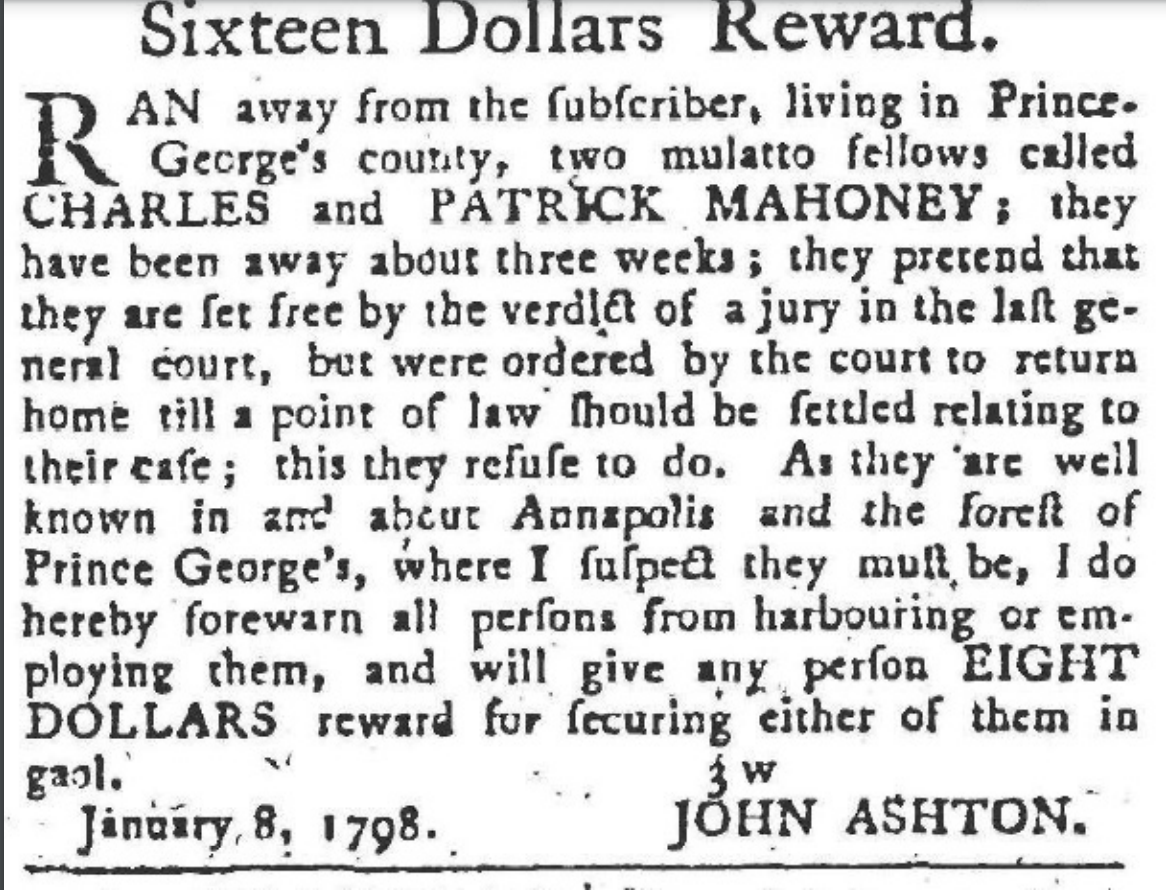
John Ashton runaway ad for Charles and Patrick Mahoney
Sixteen Dollars Reward
Ran away from the subscriber, living in Prince George’s county, two mulatto fellows called Charles and Patrick Mahoney; they have been away about three weeks; they pretend that they are set free by the verdict of a jury in the last general court, but were ordered by the court to return home till a point of law should be settled relating their cafe; this they refuse to do. As they are well known in and about Annapolis and the forest of Prince George’s, where I suspect they must be, I do hereby forewarn all persons from harboring or employing them, and will give any person EIGHT DOLLARS reward for securing either of them in goal.
John Ashton
January 8,1798
The name Charles served in the Carroll family as way to connect themselves and their mission to the Stuart family, and the men named Charles who served as the Catholic kings of England. Maryland was essential founded as a haven for Stuart loyalists fleeing England and Ireland from the government that overthrew and killed Charles II. When the Carrolls came to Maryland and effectively became in charge of who got what land in Maryland, they did so with the agenda of increasing their own power but did so under the auspices of the Stuart agenda. Enslaving African people and colonizing the Western Coast of Africa was part of that mission. What the Stuarts and Carrolls may not have anticipated was the black enslaved Marylanders using the name Charles for their own agenda. At the dawn of Charles Carroll the Settlers slave empire Charles Edward Stuart, or Bonnie Prince Charlie, was born and became the imaginary heir of the Stuart Empire, living in exile. Charles was also nicknamed “The Young Pretender.” A reference to him pretending to be the rightful king of England, despite being in exile. In his runaway ad for Charles Mahoney, John Ashton says that Charles and his brother Patrick “pretend to be free” maybe a reference to the name Charles, but definitely a reference to the fact that Charles Mahoney had won freedom for he and his brother Patrick in court. However Charles Mahoney had seven brothers, the majority of which would never be free. Two of Charles' brothers brought cases against Mahoney that were thrown out of court???. Charles Mahoney won his case, but his seven brothers remained slaves until their death despite having the same legal rights to freedom. In all of these cases, the black plaintiffs were not allowed to testify. And in all of these cases, Ashton supplied white witnesses who intentionally broke their oaths before God in order to keep the legally-free people enslaved. This is why slaves were not allowed to read and write, because they would have not only made a strong case for their similarities to the Israelites of the Old Testament, a connection that would have undermined the moral high ground on which the U.S. stood in opposition to the English crown, but also made clear the obvious intentions of white American slaveholders to cast themselves as the pharaohs of a new Egypt.
Long before his trial, Senator Charles Carroll of Carrollton had struck an agreement with the enslaved Mahoneys that he “would abide by the court decision if they would refrain from launching freedom suits against him. He wished to avoid the court costs.This arrangement wasn’t entirely a concession though, by making the suits indirectly against the main stakeholder in their enslavement the enslaved plaintiffs added another obstacle to a seemingly impossible ambition. Imagine striking a deal with somebody who stole your car not to prosecute them and to find somebody else, that would just make it more difficult to get your car or money back, right?
Despite this Charles Mahoney won his lawsuit. So Carroll followed through with his promise and made a list of twenty-three people on his home plantation at Doughoregan Manor who had ‘obtained their freedom’ based on the court decision Mahoney v Ashton. “He calculated their total value at $527.04 and made a notation for each individual…”
“The Jesuits, the Carrolls and many others feared the unraveling of slavery on their plantations, as well as the potential financial losses if hundreds of Mahoneys family members went free. Neither the Jesuit trustees nor Bishop Carroll trusted John Ashton to defend their interests against the Mahoneys.”
“Ashton’s vulnerability as a defendant jeopardized all the slaveholders ever associated with the Jesuits, including the most prominent conservative in the state, Charles Carroll of Carrollton. Leader of the Maryland Senate, signer of the Declaration of Independence, Carroll held more than 60 Joice descendants in bondage. In 1790, he enslaved 365 people. Carroll once referred to the Reverend Ashton as a ‘silly, peevish, disagreeable man,” but when Charles Mahoney sued Ashton for his freedom, the aristocratic senator and the irascible priest shared a common predicament: together they faced the unattractive prospect of freeing hundreds of people they preferred to keep enslaved.” The sundry litigations, their victories, and the unsuccessful nature of domestic relocation, made another solution necessary. The Baltimore Iron Company was not as subtle a solution as it was prior to revolution in the days of Lucy of the Ironworks.
Pharaoh and Moses b. 1784
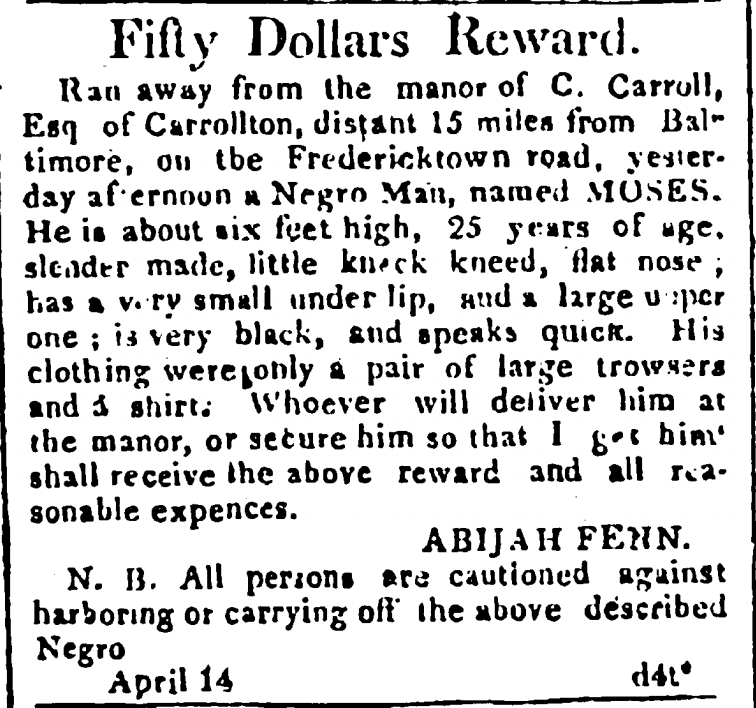
Carrollton middleman Runaway Ad
“Ran away from the manor of C. Carroll Esq. of Carrollton, distant 15 miles from Baltimore, on Fredericktown Rd. yesterday afternoon, a Negro Man, named Moses. He is about six feet high, 25 years of age, slender, little knock kneed, flat nose, has a very small under lip and a large upper one; is very black, and speaks quick. His only clothing was a pair of large trousers and a shirt. Whoever will deliver him at the manor, or secure him so that I get him, shall receive the above reward and all reasonable expenses. N.B. All persons are cautioned against harboring or carrying off the above-described Negro.”
The ban on transatlantic slave trade made slave owners more dependent on the slaves they did have. More dependent on the reproduction of enslaved women. And more dependent on the effectiveness of the runaway ad.
The enslaved people that did runaway had to be recaptured. But unbeknownst to them the runaway ad would reveal the agency of the enslaved.
How names were more than just designations but missions, callings, and intergenerational spiritual practice. The name Moses was being used to designate men who would
Six years after John Ashton’s ad for Moses and his father, all the local newspapers in the Baltimore and Annapolis areas published another runaway ad placed on behalf of CCC seeking another man named Moses. We know this Moses is not the same Moses in the Ashton ad because of his age, though the age is close enough to raise suspicion. If Moses was 25 in 1809, he was born in 1784. In Ashton’s ad, Isaac’s son was 15 in 1803, making him born in 1788.
This ad, published in April, 1809, by Abijah Fenn, a hired overseer, identifies Carrollton as Esq., a title he hadn’t exactly earned as a result of dropping out of his legal education many years before. There was, however, a man who lived less than 10 miles from CCC, who was a lawyer and often went by Charles Carroll Esq. , CCCs first cousin and business partner. The inexactitude of the ad may very well have been intentional.
Charles Carroll Confusion
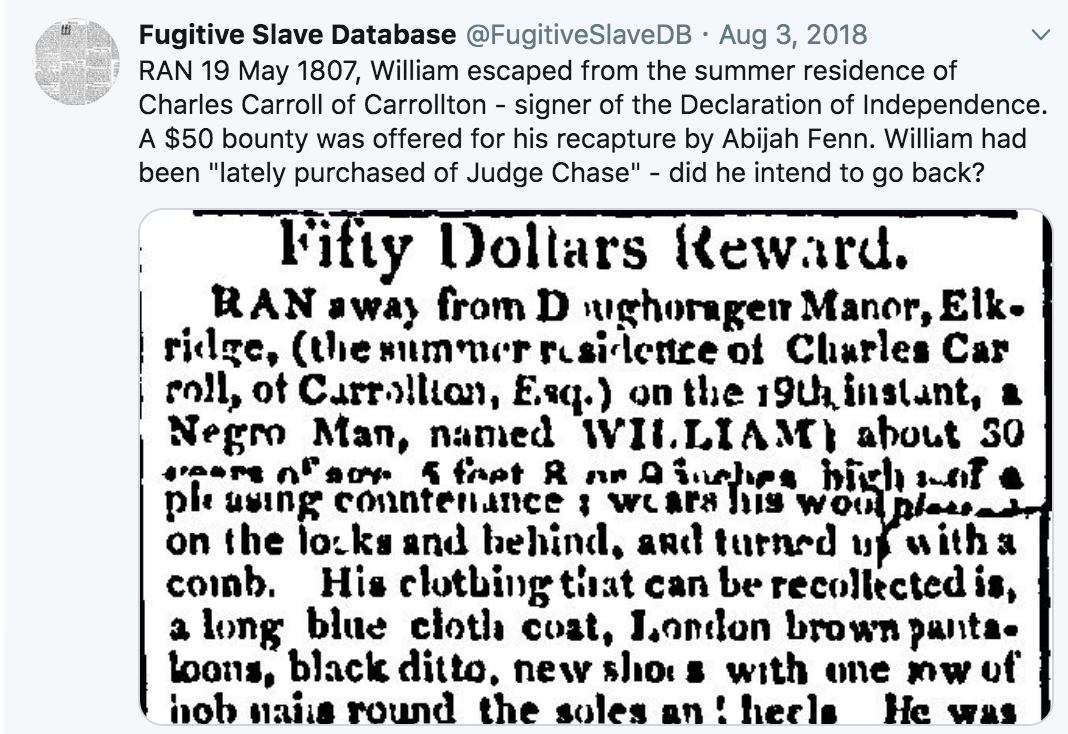
The caption is referencing Supreme Court Justice Samuel Chase
With only a quick historical glance, you might get CCC confused with another Charles Carroll, who lived at the same time as his cousin. CCBarrister, differentiated from CCC by the Barrister title at the end of his name, could also be differentiated from Carrollton in the fact that he was Protestant. Though there are instances where Carrollton uses Barrister, to play on this confusion to their benefit. CCBarrister was named Dr. Carroll, whether or not he is an actual doctor is unclear. In 1722, Dr. Carroll married Dorothy Blake of Talbot County on the Eastern Shore of Maryland. On Sunday, March 22, 1723, their first son, Charles, was born. Dr. and Mrs. Carroll had two other children, John Henry and Mary Clare. In addition to being a cousins, the CCC and CCBarrister were also linked through mutual investment in the Baltimore Iron Company.
This chapter shows that for the enslaved people on the Carroll plantations, and in the Chesapeake, that naming could be a matter of freedom.
That wrapped up in the oppressive lack of agency were… For three generations and nearly 100 years, descendants of Mary Queen named their children Queen as a way of preserving their family memory and advocating for their freedom. For Moses Queen this is doubly true, his name is a combination of two naming traditions…
Also mentioned in his will were several tracts of land that he bequeathed to his close friend, Rev. Notley Young. Rev. Ashton also provided in his will that two youth's, Charles and Elizabeth Queen, (children of Susanna Queen) were to receive the unalienated part of a tract of land called Litchfield in Charles County where they already lived. The Queen's were also given horses, hogs, cattle, and utensils. In addition to the livestock, Ashton left Charles and Elizabeth Queen, a negro man called Butler and a negro woman called Linny and her children.17 Ashton does not mention the race of Charles and Elizabeth Queen in his will, but it is possible that they are relatives of the family that fled from the White Marsh.
By the early 1800s, CCH and Ashton, once constant presences in CCC’s home, were both local embarrassments. At the center of their ignominious reputations were their inability to control the black people under their watch.
CCH’s and Ashton’s failures justified CCC’s distanced cruelty, but both were probably acting out in parody of how CCC’s actual personality (half slave-trading Captain Hook, half Ebenezer Scrooge) deviated from his public celebrity as patriot and religious liberator. Though his praise of harsh punishment and indifference to the sufferings of his enslaved people are well documented, his direct interpersonal contact is not.