Chapter 1: Pharaoh v Moses
List of Abbreviations
The story that unfolds in these pages involves the long lineage of Charles Carroll, the only Catholic signer of the Declaration of Independence. He is commonly referred to among scholars, and herein, as Charles Carroll of Carrollton, The Signer, Carrollton, and CCC. His grandfather, the original Charles Carroll, who immigrated to America in the 1400s, is referred to interchangeably as Charles Carroll the Settler, the Settler, or CCS, and CCC’s father is referred to as Charles Carroll of Annapolis, Annapolis, or CCA; The heirs of Charles Carroll of Carrollton are as follows:
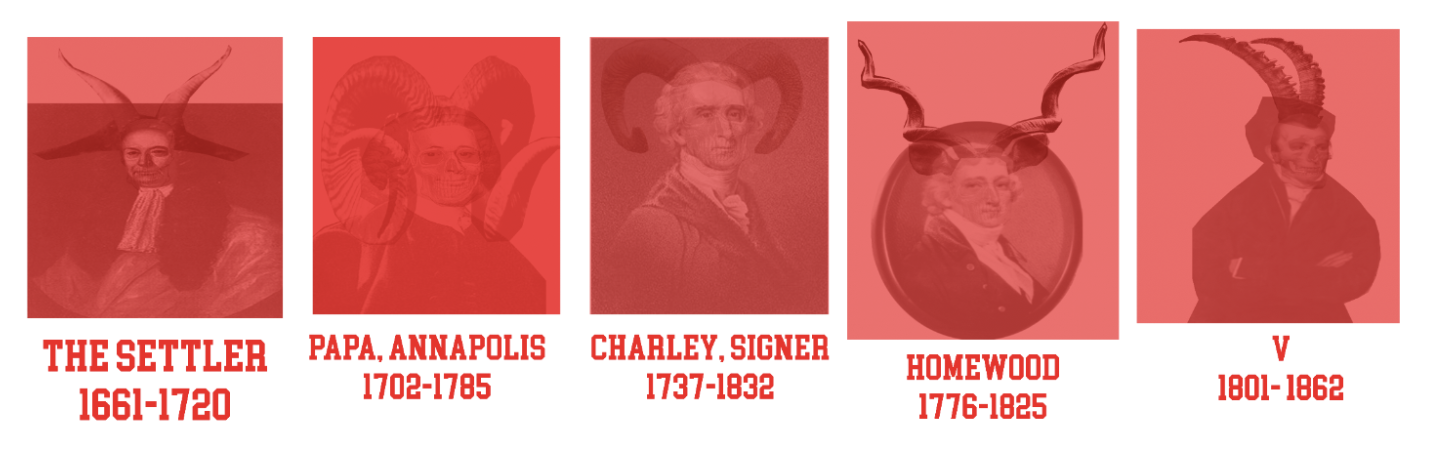
CCS - Charles Carroll, the Settler
CCA - Charles Carroll of Annapolis
CCC - Charles Carroll of Carrollton
CCDuddington - Charles Carroll of Duddington
CCMountClare - Charles Carroll of MountClare, The Barrister
CCH -Charles Carroll of Homewood
CCD - Charles Carroll of Doughoregan
CCMcTavish - Charles Carroll McTavish
Dona B or DBKV - Dona Beatriz Kimpa Vita
RAC- Royal African Company
“The Society” - both the Jesuit Society of Maryland and the American Colonization Society
Naming- refers to the naming practices used on plantations both by the enslaved people and by the enslavers. Once brought to Maryland and sold, an enslaved person was given a new name by the purchaser, who most often chose a Christian name. In the case of the Charles Carroll family, we see the use of Christian names, family names, and the same names used repeatedly. This is also true for the enslaved. This book looks at how the naming practices among the enslaved people were integral to their religious and conjure practices, specifically, the name Moses.
The Queen Family- Enslaved people have been suing for their freedom in the courts since the mid-18th Century. The Queen v Hepburn case, brought on behalf of Mina Queen and her daughter, is the most celebrated petition for freedom in U.S. history. The case reached the Supreme Court and is significant as the case that established the hearsay rule.
Ezekiel’s Wheel- refers to the wheel-like image in the Book of Ezekiel. It is a cosmogram that represents the universe, the path traveled through this world, and the afterlife, and it stands for the enduring connections between this world and the next, the power from above and below. (https://www.nytimes.com/2016/11/08/science/ezekiels-wheel-ties-african-spiritual-traditions-to-christianity.html)
“Sent Down the River”- refers to the practice of Maryland slaveholders of selling their enslaved to plantations in Southern states, where the work was far more grueling and dangerous for the enslaved. The enslaved understood that their lives would be considerably harder and their lifespans considerably cut short by such a move. Word of this reality spread through the plantations primarily by the fortunate few enslaved who were able to return from the Southern states back to Maryland. The threat of being “sent down the river” refers to the ongoing, oft-threatened use by slaveholders to control unruly behavior and to keep their enslaved from running away. And the threat was real.
I. The Many Moseses of Maryland
When Israel was in Egypt land,
Let my people go!
Oppressed so hard they could not stand,
Let my people go!
Go down, Moses, way down in Egypt land,
Tell old Pharaoh to let my people go!
“Thus spoke the Lord,” bold Moses said,
Let my people go!
“If not, I'll smite your firstborn dead!”
Let my people go!
Harriet Tubman was not alone. There were many Black Moseses before her, enslaved people aspiring to free their people from the pharaoh. In fact, many of them, like Harriet’s younger brother, were black men named Moses in Maryland. In the full arc of slavery in the United States, Harriet came late in the game. Harriet Tubman was born in 1822, the same year a man named Denmark launched a slave rebellion a couple of states over in South Carolina. 40 years later, she led a raid in the same area where Denmark Vesey led a slave rebellion. Chosen, wandering Africans had been in North America for two hundred years prior to Harriet Tubman’s birth and had waged many failed revolutions before the Civil War's victory, including a revolutionary era in Harriet Tubman’s youth: the 1830s. The 1830s were a time of revolution for black people all over the world. Nat Turner’s rebellion in nearby Jerusalem, Virginia, the Sharpe Rebellion that liberated Jamaica all took place in the early 1830s. Harriet Tubman was 10 years old when a group of men, led by Moses, led runaways and escaped themselves from Declaration of Independence signer Charles Carroll of Carrollton's plantation at his death, a few miles away in Ellicott and Baltimore, Maryland. Tubman, born Ross, would become the most famous Moses in a tradition that this book will trace to Western Africa.
II. REBELS OF THE PLANTATION
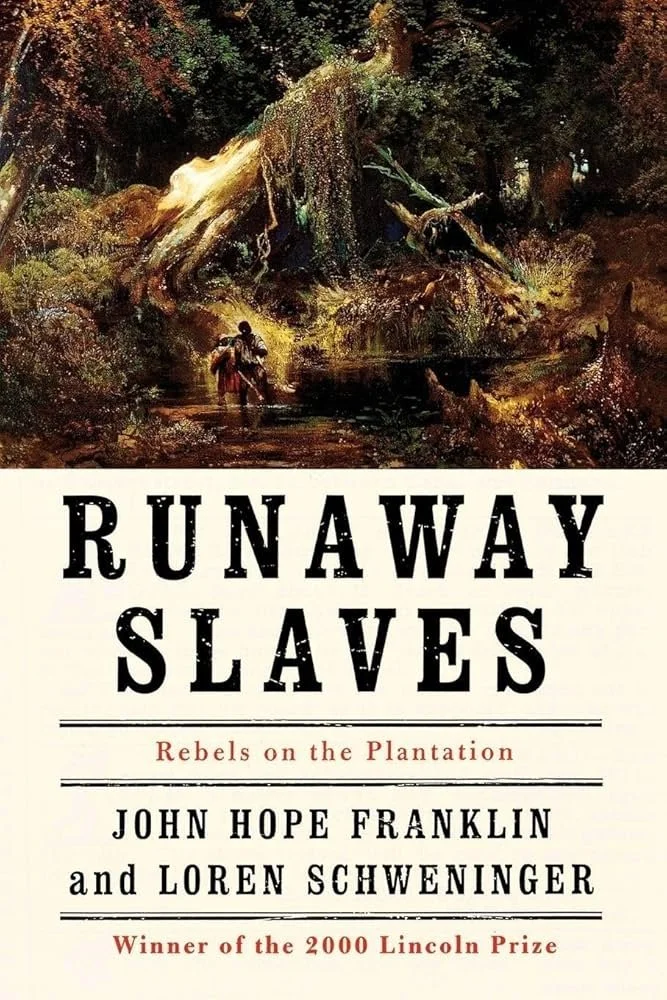
I first found the name Moses in the Carroll papers, by chance, in a retelling of an enslaved man named Moses escape in 1832 at Carrollton’s death. A Google search for Carrollton slaves conjured up a book called “Runaway Slaves: Rebels on the Plantation” by John Hope Franklin and Loren Schweninger. The book told the story of the most famous Carroll, CCC’s death and the escape of an enslaved man named Moses with two accomplices. Though I did not know it at the time, the story became the crux of my work on my family genealogy. As a religion student, baptized Catholic, and descendant of Black American slaves I couldn’t help but see the symbolic significance of an enslaved man named Moses running away at his masters death. It felt Biblical then.
I wanted to know more about Moses. Who was he? Did he get away? As I went further down the rabbit hole, I discovered many other enslaved men named Moses, who were enslaved by the Carrolls. Not just contemporaries of runaway Moses, but fellow runaways. Not just in this generation of Carroll slaves, but in over 100 years of Carroll slaves. Was this a coincidence? Even then, it felt like something more significant than happenstance.
The book told the story that ten days after Charles Carroll of Carrollton’s death, Charles Carroll of Doughoregan, Carrollton’s grandson, arrived and demanded the keys to ``the Pantry,” as well as a listing of all of Carrollton’s personal holdings and rental incomes but it did not tell the whole story.
CCD was anxious to get full control of his grandfather's estate to exact his revenge on the enslaved families he blamed for the ruin of his. CCD life was defined by his father’s violent conflict with the black people he owned. His father had completed construction on the most expensive house in Baltimore the year he was born. After that, his life began to descend into scandal, violence, and early death. At the center of the scandal was the house. As mentioned in the preface, CCH was constantly violent against his aristocratic Philadelphia wife, Harriet Chew. Family drama reached a climax when Harriet Chew fled Baltimore with a young slave, named Charity Castle, whom CCH had sexually assaulted.
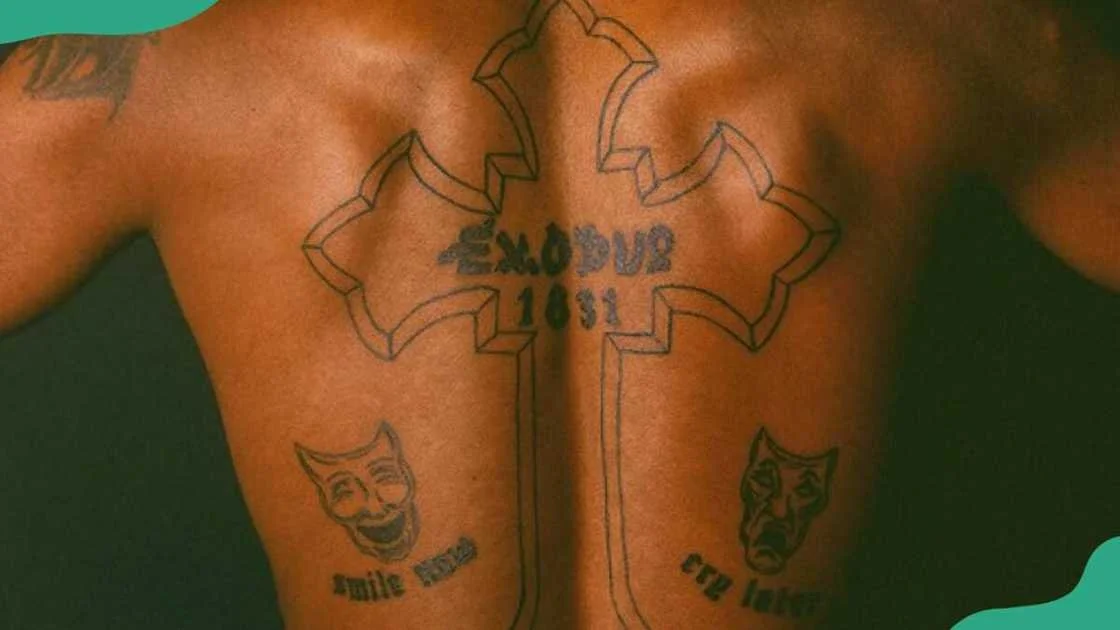
Tupac’s back tattoo with “1831” underneath “Exodus”
When Tupac was walking to and from high school at Baltimore School of the Arts, he likely did not know that he was walking on what used to be the Belvedere Estate belonging to John C Howard, the brother-in-law of Harriet Chew, husband of her sister. She would often run here when CCH had beaten her up. Tupac also likely did not know that he was down the street from where a group of enslaved men embodied the mantle he would inherit from his mother, Afeni Shakur, and the Black Panthers, the liberation of black people. In fact, Tupac conscious or not would make this connection explicit when he got the year 1831 tattooed on his back to symbolize the Nat Turner revolt, which took place on the day of the Haitian Revolution. Tupac intentionally connected himself to the Haitian Revolution through Nat Turner. If you think I’m stretching his revolutionary symbolism aspirations beyond where he himself saw them, look up the tattoo online. 1831 is a significant year for our story. Nat Turner sent shockwaves through the entire slaveowning world, including the world inhabited by the Carroll slaves. But one year later, their entire world would be flipped on its head.
III. THE BEACH

Homewood Museum, aka The Beach, John Hopkins University
Just months after Carrollton’s death, England began to dismantle slavery in the rest of its empire with the Slavery Abolition Act of 1833. And as slavery began to die down in the British empire, it was gaining momentum in the United States. Nobody embodied this more than CCD.
Johns Hopkins Undergraduate Campus is built around a beautiful 19th-century Georgian mansion, built by CCD’s father. The lush green hill in front of the former plantation is jokingly nicknamed “The Beach” because of the way students congregate in the area to lie out, catch some sun on sunny days, picnic, or even study. Very few, if any, students knew that the Homewood building was a plantation with a sordid history. The enslaved men, Moses, John, and Andrew, were very aware of this history when they hid there as part of their escape at Carrollton’s death. When the plantation manager, William Gibbons, who had been at the Manor for eleven years, refused, the younger Carroll ordered him off the property, threatening to use force if necessary. CCD had overestimated its ability to control the enslaved population. They either outright refused to work or just milled around. Some were hiding out, others escaped altogether. Among the escapees were Andrew and Moses, who told others that this was their chance to break for freedom. Few were willing to go to such extremes, but one recruit, John, joined the two runaways. The three went to nearby Homewood Plantation, hid out in the slave quarters, and began to make plans for the future. But Homewood wasn’t a random choice. It was a CCD’s blind spot. The house symbolized his father’s financial inability, his failed aspirations for acclaim in the city. It had been abandoned and neglected.
In fact, each CC is named for a property that reveals something about them and their aspirations. CCSettler was the first to settle in Maryland. CCAnnapolis symbolized how that Charles Carroll had literally come up as Annapolis became a city and the center of the Carroll empire. CCCarrollton was named for the land his father intended to steal from his brother, CCC’s uncle Daniel Carroll of Duddington. CCHomewood was named after a mansion he built to distinguish himself from his father, to his detriment, which is now the central building of Johns Hopkins.
And lastly CCDoughoregan, CCDoughoregan's name intends to do the opposite of his father’s. In the same way, CCHomewood built the most expensive house in Baltimore (in 1801) to distinguish himself from his father, HIS son would give himself a name that would intentionally conflate him with his grandfather. CCDoughoregan named himself after his grandfather’s estate as a subtle erasure of his father’s legacy and the property that inspired his name. CCD was defined by his single-minded focus to both erase his father’s legacy and amplify his connection to his grandfather and his success in slavetrading. The enslaved people, likely to be inherited by CCD, knew this as well and rebelled in every way imaginable when he fought to inherit them.
In the midst of this turmoil, only a week and a half after younger Carroll had arrived, William Gibbons was brought back and put back in charge.
CCD was not able to manage the D.
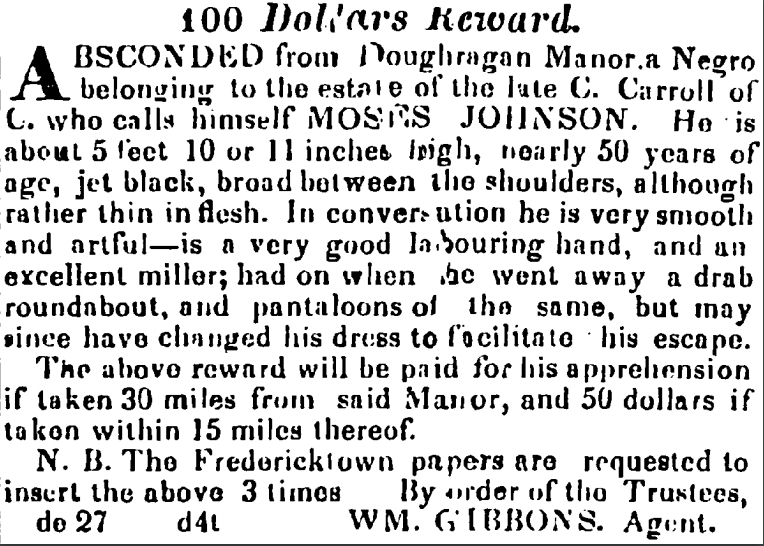
William Gibbons runaway ad for Moses on behalf of Charles Carroll, 1832
William Gibbons did not have the same blind spot as his new employer, traveling first to Baltimore, then to Homewood, where he found Moses and his accomplices. Andrew refused to be taken without a fight and punched Gibbons’s assistant in the mouth with his fist before being subdued. He was put in jail. Moses and John promised to reform themselves if they were allowed to return, and Gibbons acquiesced. No sooner had they returned, however, than Moses again ran away, and this time he, too, was incarcerated. Andrew was ‘always refractory,’ the manager said, and Moses was ‘very much of a desperado.’ What was worse, they were obviously having a ‘very improper influence upon the rest of the men.’” Andrew and Moses were sold at auction. After word of the sales spread through the quarters, Gibbons said, the `people have had disorderly conduct.” Franklin and Schlenginger used the example of Moses’ behavior to show how the deaths of slave masters were events often marked by escapes and escape attempts by enslaved people. The death of Charles Carroll of Carrollton was symbolic of the end of one revolutionary age and the dawn of another. Though it would be 30 more years before their white counterparts were willing to answer the call, the 1830s were a decade of black revolution.
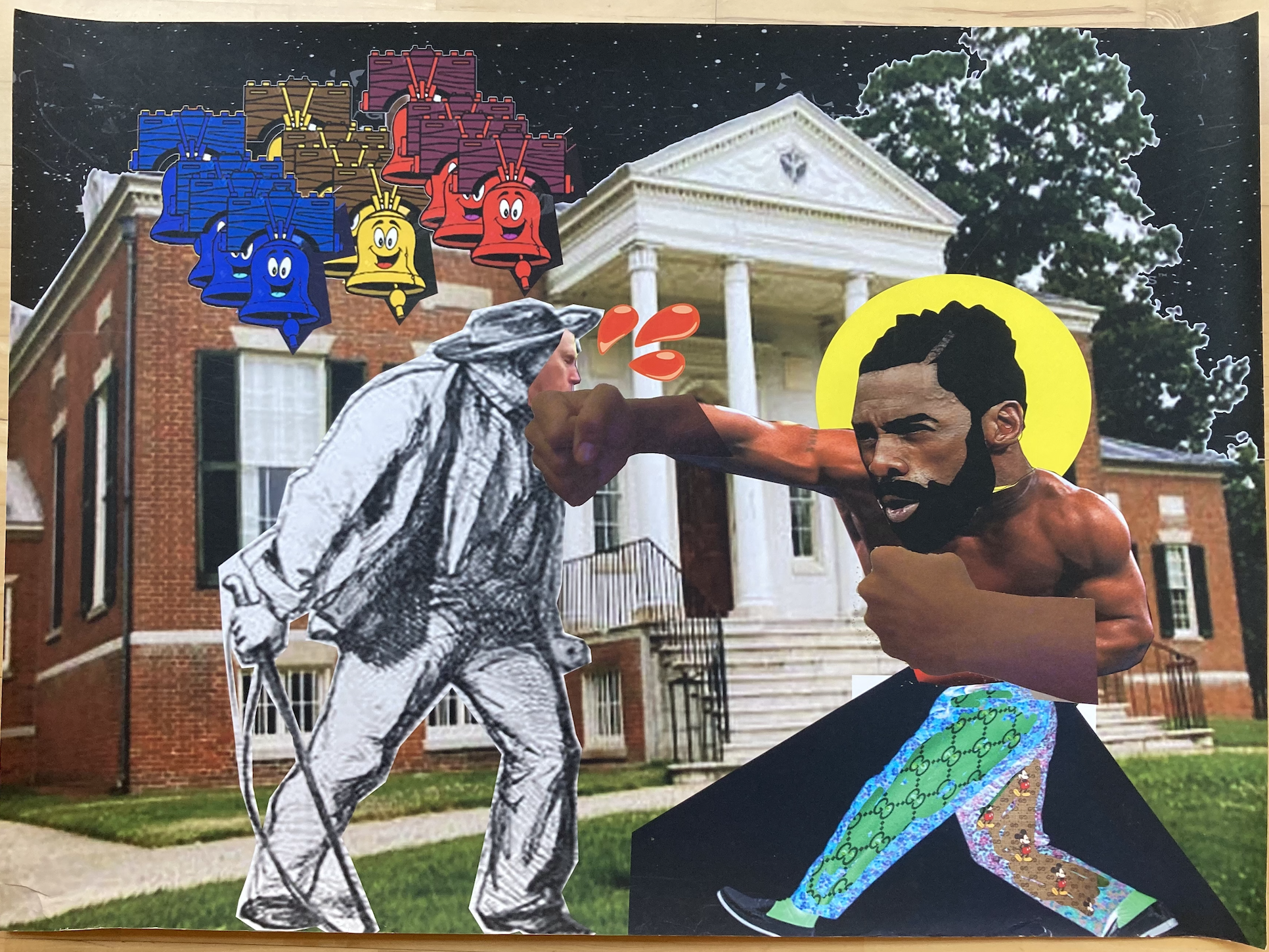
“Andrew at Homewood” 2020, 24” x 36” mixed media
The spirituality of “Go Down Moses” is at the center of African American religious identity and embodies the 1830s in sonic form. At the tumultuous beginning of the 19th century, with its trains, industrialization, and burgeoning world economy, African Americans, both free and enslaved, viewed themselves as the chosen people of the Bible: destined to be freed by a fearless leader who would confront their oppressors with God’s wrath. Free Northern black people met in conventions to debate the path to black liberation. And the enslaved people who worked the land, that would be known as the Beach, would not experience their own liberation for another 30 years.
IV. THE BLACK BUTTERFLY
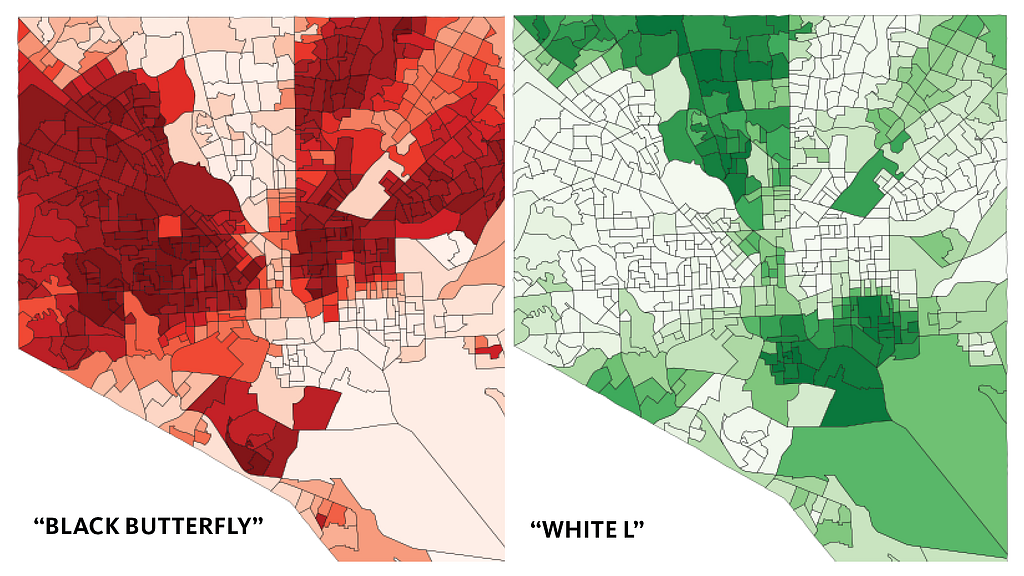
Visualization of Black Population of Baltimore
In the meantime CCD exacted his revenge. The year the British ended slavery, sold Homewood and sent an enslaved man named Moses Addison, a shoemaker, to his death at a plantation in Louisiana on a ship named after his mother, the Harriet. CCD’s mothership.
While the majority of Southern and Northern whites sought a way to compromise around slavery without having to acknowledge black humanity, the tensions that built up to the Civil War foretold an apocalyptic end to the United States slave economy that was on God’s time, not theirs.
The end of the world was coming, and God would deliver his people.
Northerners and those on the periphery of the Southern planter oligarchy would rush to the side of the chosen in what the nation had decided would be the battle of good vs. evil, Union vs. Rebel, enslaved vs. enslaver. Despite the mythology around the Civil War, black Americans would only see a glimmer of liberation before being re-submitted to another, equally dehumanizing form of subjugation. The roots of segregation throughout the South, from the end of Reconstruction to the Civil Rights Movement, took hold on Baltimore soil first.
The number of free blacks that populated the city, its proximity to the Mason-Dixon line, and the state capital made the soil ripe to grow a tree from which many black men, women, and children would be lynched, jailed, humiliated, or some cruel combination of all three.
Before and after Jim Crow, and despite censuses and laws that created topographical lines that are the silhouette of the black butterfly, the racial complexity of Baltimore transcends all modern definitions. As difficult as it is to understand race in America, Baltimore is exponentially more so. Since the late 1700s, black Marylanders have sued their masters for their freedom, and occasionally won. The fact that there were such large populations of free black people in Baltimore during slavery makes it hard for many white people to understand how the mental and physical torture of slavery defined the city and the oppression of its black residents, enslaved or free. Free black people or their children could be jailed, enslaved or sent “down the river” at any time. Black people taking legal action to fight for their freedom filled the Baltimore Orphans Court docket, as well as dockets in Maryland cities and counties across the state.
It was the land of Charles Carroll of Annapolis that would create the earliest parts of Baltimore, the city, and it was the racial and labor relations on his plantations that would come to define the ethos of the city: the downtown streets named after prominent Catholic slave-owning families, the slave jails that dotted the downtown streets, the centrality of the port that brought in and shipped out thousands of African people. Charles Carroll of Annapolis’ son (CCC) would become nationally famous and remembered for being the sole Catholic signer of the Declaration of Independence, a symbol of religious tolerance in the United States.
But to the African-descended people they enslaved, Charles Carroll embodied the Biblical pharaoh, the sworn enemy of Moses and of God himself.
Even before the Civil War, Baltimore's black population was already something the slaveholders hadn't planned for, a city where the enslaved and the free lived side by side, where the same streets that bore the names of Catholic slave traders also bore witness to black people suing for their freedom and winning. What started as a slavery caterpillar, crawling through the tyranny of the Carroll empire, was already becoming something else. The black butterfly whose silhouette would eventually be traced by census lines and redlining maps had already begun to take shape, wings made not of freedom granted, but of freedom taken, inch by inch, lawsuit by lawsuit, runaway by runaway, name by name.
V. AMERICAN PROPHECY
For the enslaved people of the Carroll family and the wealthy planter class of the region, Moses meant two different things. White Americans, including the Carroll, believed themselves to be chosen people whose capture of land, people and resources was divinely orchestrated. On the Carroll plantations of Maryland, the spiritual Go Down Moses was prophecy. Inspired by Exodus 12:29, the prophecy was fulfilled when Charles Carroll of Homewood died on April 3, 1825. In Exodus 12:29, Moses tells Pharaoh that God will kill all the firstborn sons of the Egyptians, including Pharaoh’s, unless the Jewish people are freed.
When Pharaoh refuses, his firstborn son dies.
Charles Carroll of Homewood was the infamous firstborn son of Charles Carroll of Carrollton, and his death foreshadowed the tensions that made the Civil War inevitable. “Go Down Moses” was a popular spiritual song, very likely sung by Carroll’s enslaved people, and was used by black Marylanders in the mid-nineteenth century as code for plans to run away, including those who ran away with Black Moses (Harriet Tubman).
In the Civil War, Harriet was not a ship that took Moses deeper into slavery, but Moses taking her people far away from bondage.
And just as the Exodus-inspired spiritual prophesied, God had taken CCC’s firstborn son to announce his intervention in their suffering. By the time of his death at age 95 in 1832, CCC had outlived his firstborn, CCH, by 8 years. And thirty years later, the Civil War would take many sons. Unlike the story in Exodus, however, Moses in this story would not have a chance to liberate his people.
There is no one act that saves black people in America, no one march, no one rebellion, no one man delivering laws from the mountaintop. There is no staff turned into a snake, no army thrown into the Red Sea. For black people in America, Moses is many men and women, all dedicated in their own way to liberating their people. In the last two chapters, we learn about black women and men who carried out the tradition after slavery, laying the foundation for Public Enemy, Tupac Shakur, and others.
Exodus is only partially spatial; the temporal aspect of our Exodus is still ongoing.